


Before You Go—Let’s Boost Your Leads!
Join our community of successful HVAC and Plumbing contractors who trust Klutch Growth to enhance their online presence.
Klutch Growth Blog
Best way to win back lost HVAC customers
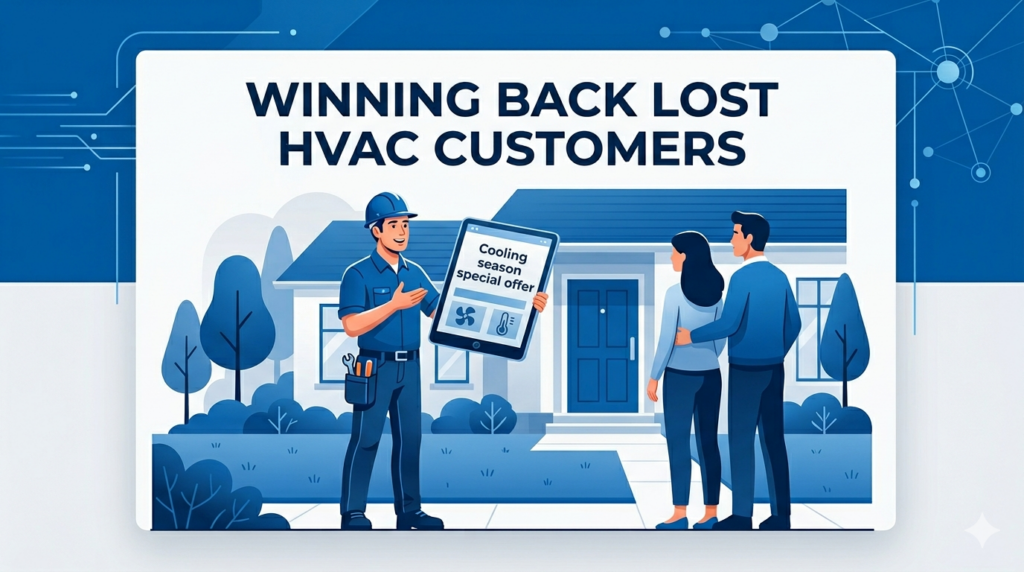
WIn back lost HVAC customers
Think about the last 20 customers you serviced. How many of them called you back for a second job? If the answer is fewer than half, you’re not alone. Most HVAC businesses quietly lose repeat business without even knowing. Most times, we assume customers are one-offs, when it’s often that they churned because no one followed up.
The hard part is that it’s usually not about the quality of your work. Most of the time, lost HVAC customers result from clients seeking only a quick fix. It’s your job as the HVAC professional to get your clients to buy into routine maintenance. Of course, this doesn’t mean pushing HVAC jobs that offer no value for clients, because that’s really off-putting; we’re talking about valuable deals here.
Here’s the good news: a solid chunk of those customers can come back. They already know your business, they’ve trusted you with their home, and they need far less convincing than a cold lead ever would. This guide walks you through exactly how to reach them, what to say, and how to make sure they don’t go quiet again.
What is a lost HVAC customer?
A lost HVAC customer is someone who used your service before but hasn’t contacted you again. They already know your business, they’ve seen your team at work, and they trusted you enough to let you into their home. That trust doesn’t disappear just because time passes.
Lost HVAC customers typically fall into one of these groups:
- Past customers who scheduled service once or twice, then stopped calling
- Old quotes that didn’t close because nobody followed up
- Missed calls from people who never rebooked
- One-time job customers who didn’t hear from you after the job was done
Some of our clients are surprised when they pull their customer lists and realize just how many people fall into these categories. The number is almost always bigger than expected.
Why HVAC customers stop calling you
HVAC customers stop calling because they either forget your business or find another company first. Most of the time, it has nothing to do with bad service. It comes down to one simple thing: nobody reached out.
The most common reasons customers drift away:
- No follow-up after the job was completed
- A frustrating experience, even a small one, that went unaddressed
- Confusion around pricing or what the service actually includes
- A competitor responded faster when they searched online
Interestingly, the speed issue is more common than most business owners realize. If your business doesn’t show up among the top 3 search results, or you’re slow to answer, someone else gets the job.
The seasonal nature of HVAC makes this worse. Long stretches of no communication mean customers essentially have to start from scratch every time they need help. By the time they need a repair or tune-up, your number is buried three phones ago.
Why winning back customers is easier than getting new leads
Winning back old customers is easier because they already trust your work and need less convincing. A brand new lead has never heard of you. They don’t know if you show up on time, whether your pricing is fair, or if your techs actually know what they’re doing. A past customer already has answers to all of those questions.
There’s also the timing advantage. HVAC systems need attention at least once a year, and most homeowners know it. That means every past customer on your list is a potential job sitting in a predictable window. You don’t need to convince them they need service. You just need to be the one they call when that window opens.
The U.S. Department of Energy recommends that homeowners schedule professional AC maintenance at least once a year. You can use such educational leverage to keep your clients in touch without being salesy.
Beyond the timing, winning back customers also tends to be faster and cheaper:
- No ad spend required to reach them
- Decisions happen faster because the trust is already there
- Conversion rates are significantly higher than cold outreach
Of course, this only holds if your customer didn’t leave because of a bad experience. If they went quiet after a frustrating job, the approach changes slightly. We cover that in detail in our guide on why HVAC businesses lose customers to competitors.
How to win back lost HVAC customers (step-by-step)
Step 1: Find your past customers
To win back customers, start by collecting your past customer list. This sounds straightforward, but many HVAC businesses don’t have their customer data in one place. It’s spread across a CRM, old invoices, a call log, and maybe a stack of paper job sheets from two years ago.
Pull together contacts from all of these sources:
- Your CRM or service software
- Past invoices and job records
- Inbound call logs
- Old quotes that were sent but never followed up on
Once you have everything in one place, you’ll have a clearer picture of who to contact and how long it’s been since their last job.
Step 2: Focus on high-value customers first
Not all past customers are worth the same outreach effort. Focus first on the ones who previously spent more or used your service more than once. These are the customers most likely to rebook, and they’re also the ones who could generate the most revenue when they do.
Prioritize customers who fit any of these profiles:
- Repeat customers who booked more than once
- Customers who paid for bigger jobs, like full installations or system replacements
- Customers who used your service within the last 12 to 18 months
More recent customers are easier wins because your business is still fresher in their memory. Start with them, then work your way back through older records.
Step 3: Send a simple message
Send a short message that checks in without selling. This is where most businesses go wrong. They either say nothing for months or lead with a generic discount pitch. A simple, personal check-in works better than both.
Something like: “Hey John, just checking if your AC is still running fine going into the summer. Let us know if you need anything.”
A short message like this tends to get responses precisely because it doesn’t feel like a marketing email. It feels like a contractor who actually remembers who they worked with.
Step 4: Offer a simple deal
Give a small incentive to encourage them to book again. This doesn’t need to be a big discount. A modest offer paired with a reason to act is usually enough to tip a warm customer into booking.
A few offers that tend to work well for HVAC win-backs:
- A small discount on their next service or tune-up
- A complimentary filter check or inspection with any booked job
- Priority scheduling during peak season
The offer gives them a concrete reason to act now rather than putting it off again. Keep it simple and make it easy to redeem.
Step 5: Contact them at the right time
The best time to contact past customers is before peak seasons or three to six months after their last service. Timing matters more than most businesses give it credit for. A message sent in late March, just before peak season kicks in across markets like Miami, Dallas, or Phoenix, lands at exactly the moment a homeowner is starting to think about their AC.
Conversely, reaching out during peak season means you’re competing with every other HVAC company for an already-busy customer’s attention. Getting ahead of the rush gives you a cleaner shot at the booking.
The three- to six-month window after a completed job is also worth noting. Systems don’t usually fail right after a tune-up, but enough time passes that a follow-up feels natural rather than pushy. A quick check-in at that point keeps your business top of mind without feeling like you’re chasing.
Step 6: Stay visible when they search “near me”
Even if you reach out directly, customers often search online again before they decide to book. Your business needs to show up when they do. A past customer who gets your message and then Googles your business name should see a profile that reinforces their decision to call you back.
Three things that keep you visible and credible in local search:
- A steady stream of Google reviews from recent customers
- An active, fully optimized Google Business Profile
- Retargeting ads that keep your business in front of people who’ve visited your site
Reviews deserve a specific mention here. A past customer who’s on the fence about calling you back is much more likely to do it if they see 50 recent five-star reviews. We break down exactly how to build and maintain that kind of review presence in our HVAC reputation management guide.
Best messages to win back lost HVAC customers
The message matters as much as the timing. A generic blast that reads like a newsletter won’t move many people. Short, specific, and personal works better every time. Here are three formats that tend to get responses.
-
Text message example
“Hi [Name], this is [Your Business]. Summer’s coming, and we wanted to check if your AC is running well. Reply or call us to schedule a tune-up. We’re offering priority slots for returning customers this season.”
That’s under 50 words. It’s personal, it has a light offer, and it gives them a clear next step without any pressure.
-
Email example
Email gives you a bit more room, but keep it scannable. A wall of text won’t get read.
Subject: Checking in on your HVAC system, [Name]
“Hi [Name],
It’s been a while since we last serviced your system, and with the warmer months coming, we wanted to make sure everything’s still running the way it should.
If you’d like to schedule a tune-up or have any questions about your system, just reply to this email or give us a call. As a returning customer, we’ll also knock 10% off your next service.
[Your Name], [Business Name]”
-
Seasonal reminder example
Seasonal reminders work well because they give outreach a clear purpose. You’re not just checking in randomly. You’re flagging something timely.
- “[Name], the cooling season is almost here. Book your AC tune-up now and skip the rush.”
- “[Name], it’s been about a year since your last service. Time for a quick check before the heat hits.”
- “[Name], we’re offering early-season maintenance slots for returning customers. Spots fill fast.”
Each of these examples ties the outreach to a real moment in the year. That context makes the message feel relevant rather than random, which is the difference between a customer who responds and one who ignores it.
Common mistakes when trying to win back customers
Most HVAC businesses fail to win back customers because they don’t follow up properly. The intent is there, but the execution breaks down somewhere between pulling the customer list and actually sending the message. These are the three mistakes we see most often.
-
Waiting too long to reach out
The longer you wait, the harder it becomes to win back clients. A customer you serviced eight months ago is a warm lead. A customer you serviced three years ago is close to a cold one. Businesses that put off follow-up until they’re slow tend to reach out at the worst possible time, after the customer has already settled into a routine with another company.
Building a follow-up schedule into your regular workflow, even a simple one, prevents this from happening. A quarterly review of your customer list takes less than an hour and could surface several bookable jobs.
-
Sending generic messages
A message that could have been sent to anyone tends to get ignored by everyone. Customers can tell when an outreach is a bulk send. Using the customer’s name, referencing the type of job you did for them, or timing the message around their specific service history makes a noticeable difference in response rates.
Some of our clients have found that even small personalizations, like mentioning the season or the customer’s neighborhood, are enough to make the message feel intentional rather than automated.
-
Having no system to handle responses
This one catches businesses off guard. You send out a batch of messages, a few people respond, and then those responses sit unanswered for two days because no one was assigned to handle them. That’s a second abandonment, and it’s the one customers don’t forgive.
Before you start any win-back outreach, make sure someone on your team is responsible for replies. If you’re a smaller operation running everything yourself, batch your outreach to a manageable volume so responses don’t pile up faster than you can answer them.
Is it better to win back customers or buy new HVAC leads?
Winning back old customers is usually the better starting point because it costs less and converts faster. That said, the two approaches aren’t mutually exclusive. Most HVAC businesses need both, just applied to different situations.
Here’s how they compare side by side:
Old customers:
- Already trust your business and know your work
- Lower cost to reach since no ad spend is needed
- Shorter sales cycle from first contact to booking
- Limited pool that shrinks if you don’t actively grow it
New leads:
- No prior relationship, requires more convincing before they book
- Higher cost per acquisition through ads or lead services
- Longer path from first contact to completed job
- Expand your customer base and build a long-term pipeline
The practical approach for most HVAC businesses is to work the existing customer list first. It’s the lowest-hanging fruit, and the return on effort is almost always faster than any paid lead channel. Once that’s running consistently, new lead generation fills in the gaps and grows the overall pipeline.
If you’re also looking to drive more inbound calls from new customers, our guide on getting more calls for your HVAC business covers the channels that tend to work best for local service companies.
How to get more HVAC customers using your existing customer list
The fastest way to get more HVAC customers is to contact people who have already used your service. Your existing customer list is one of the most underused assets in your business. Most HVAC owners have hundreds of past contacts and never reach out to them in any structured way.
There are three groups in that list worth working through deliberately.
-
Past customers
Past customers are your warmest audience. They’ve already had a positive experience with your team, which means the barrier to rebook is lower than any other group you could target. A well-timed follow-up, especially before peak season, could convert a significant portion of this list with no ad spend.
A few ways to work with this group:
- Seasonal check-in messages are sent two to four weeks before peak demand
- Annual maintenance reminders are tied to the date of their last service
- Referral asks, since satisfied past customers are a reliable source of word-of-mouth
-
Missed calls
Missed calls are the easiest wins most businesses leave on the table. Someone called your number, didn’t reach anyone, and moved on. That doesn’t mean they found another company yet. A quick callback within a few hours, even the same day, recovers a larger share of those opportunities than most business owners expect.
If you’re not already reviewing your missed call log regularly, start there. Set a daily or twice-daily window to return any unanswered calls before the day is out.
-
Old quotes
An old quote is a customer who raised their hand and then went quiet. They needed HVAC service, they contacted you, and something got in the way of them booking. Maybe the price felt high at the time, maybe they got busy, or maybe they just needed a nudge that never came.
Following up on quotes older than 30 days with a short message tends to reactivate a meaningful percentage. Something as simple as, “Hi [Name], just circling back on the quote we sent over. Happy to answer any questions or adjust if your situation has changed,” is often enough to restart the conversation.
Getting more out of your existing traffic and contacts also comes down to how well your website and follow-up process are set up to convert. Our guide on converting website traffic into HVAC prospects and sales walks through the key gaps that cause businesses to lose leads they already worked hard to attract.
Notes on additional HVAC lead generation
Beyond your existing customer list, there are paid lead channels worth understanding as your business scales. Two of the most common ones HVAC businesses encounter are pay-per-call leads and shared vs. exclusive lead packages.
It’s also worth noting that preventative maintenance contracts create a natural repeat business engine. The U.S. Department of Energy’s Better Buildings initiative on preventative HVAC maintenance estimates that organizations following proper maintenance best practices could save 5 to 20% on energy costs. That’s a compelling talking point when pitching maintenance plans to commercial customers.
-
What are pay-per-call HVAC leads, and are they worth it?
Pay-per-call HVAC leads are phone calls from potential customers that you pay for only when the call connects, making them high-intent but also more expensive per contact than most organic or retention channels. They could work well for businesses that have the capacity to handle volume and the margins to absorb the cost-per-call.
-
Exclusive vs. shared HVAC leads
Exclusive leads are sent only to your business, while shared leads go to multiple contractors at the same time, which means exclusive leads tend to convert at a higher rate but cost more upfront, whereas shared leads are cheaper but put you in direct competition with other HVAC companies for the same job.
Simple checklist to win back customers today
If you want to start today, here’s a short list to work through. You don’t need a CRM or a marketing budget to get started. You need a customer list, a phone, and a bit of time.
- Export your full customer list from your CRM, invoices, or call logs
- Sort by most recent service date and identify your top 10 to 20 priority contacts
- Send a short, personalized check-in message to each one
- Attach a simple offer, such as a small discount or a complimentary inspection
- Assign someone to monitor and respond to replies within the same business day
- Book the jobs and note which message format got the best response
- Schedule a follow-up reminder for any contacts who didn’t respond after 5 to 7 days
Once you’ve run through this once, it’s worth building it into a quarterly habit. Even one outreach cycle per season could add several bookings that would otherwise have gone to a competitor.
FAQs about winning back lost HVAC customers
-
How do I win back HVAC customers who stopped calling me?
Start by pulling your past customer list and identifying those who haven’t booked in the last 6 to 18 months. Send a short, personalized check-in message timed around an upcoming season or a reasonable service anniversary. Keep the message simple and include a light offer to give them a reason to act.
-
When should I contact past HVAC customers?
The strongest windows are two to four weeks before peak cooling or heating season, and three to six months after their last completed job. Both timing points feel natural rather than random, which tends to get better responses.
-
What offers work best to bring customers back?
Small, low-friction offers tend to perform better than large discounts. A complimentary filter check, a 10% discount for returning customers, or priority scheduling during peak season all give customers a reason to book without making them feel like they’re being sold to.
-
Is it better to contact old customers or buy HVAC leads?
For most HVAC businesses, old customers convert faster and at a lower cost than bought leads. Paid leads could make sense once your existing list is being worked consistently, and you need to expand your pipeline beyond what retention alone can fill.
-
How do I get more HVAC customers fast?
To gain more customers, leverage your Google Business Profile, showcase recent reviews, and ask happy customers for word-of-mouth referrals.
Final takeaway
Lost HVAC customers aren’t completely gone for the most part, and that means a well-timed message could bring a good number of them back. Your existing customer list is one of the most cost-effective sources of new bookings your business has access to. Working it consistently tends to deliver faster results than almost any paid channel.
The six steps in this guide give you a repeatable process to follow. Start with the highest-value contacts, keep the messages short and personal, time your outreach around seasons and service anniversaries, and make sure someone is ready to respond when replies come in.
If you’d like help building a retention and lead generation strategy that fits your business, our in-house experts at Klutch Growth are happy to take a look at what you’re working with.
Talk to an in-house expert — No obligations, just a conversation about what’s possible for your HVAC business.
Recent Posts
March 30, 2026
March 21, 2026
March 20, 2026
February 20, 2026