

Before You Go—Let’s Boost Your Leads!
Join our community of successful HVAC and Plumbing contractors who trust Klutch Growth to enhance their online presence.
Klutch Growth Blog
HVAC conversion rate optimization
How to turn website visitors into booked jobs
Low HVAC conversion rates often stem from unoptimized websites. Some businesses have a single-page site with barely enough content to tell visitors what they do or where they operate. Others have multiple pages but suffer from CTAs buried below the fold, copy that doesn’t speak to what a homeowner actually needs in that moment, or a design that was assembled quickly with little thought for the person trying to navigate it.
Most homeowners looking to hire HVAC service want to make a judgment call they’re sure of, and a website that looks unpolished signals a low-trust business. We once worked with an HVAC business in Miami that had a conversion rate of less than 1%. After we rebuilt their website using a more appealing design, clearer CTAs, and stronger trust signals, their conversion rate increased by 761%.
HVAC conversion rate optimization (CRO) is the skill behind such a massive jump between leads and booked jobs. With the right changes, your website will just click with visitors, so they know where to find every piece of info they need and where to book a job eventually.
A single percentage-point improvement in your conversion rate could translate into thousands of dollars added to the bottom line every month, without increasing marketing spend. And we hope you find the points under this guide useful for a practical fix to make that happen for your business.
Why HVAC websites lose visitors before they call
Getting visitors to your website is only half the job. For most HVAC businesses, the gap between lead gen and jobs booked is where the majority of their marketing budget disappears.
Website visitors rarely make a call after experiencing slow load time or seeing a website that doesn’t load properly on mobile. In some other cases, leads fail to book because they couldn’t find a call to action or phone number to contact.
According to this Shopify article, as page load time increases from 1 second to 3 seconds, the probability of a visitor bouncing increases by 32%. For HVAC businesses where most visitors are searching in urgent situations, that kind of friction is expensive.
What HVAC visitors actually want when they land on your site
In the first few seconds, they’re scanning for three things: confirmation you serve their area, a phone number they can tap immediately, and enough trust signals to feel confident you’re a legitimate business. Most HVAC websites make visitors work too hard to find those three things. That’s where the conversion breaks down.
But there’s hope! We’ve curated the top 8 areas to cover that can 10x your HVAC conversion rate. Here’s a quick overview:
- A phone number that’s impossible to miss on every device
- Video content that hooks visitors and delivers value before they scroll
- Page speed that keeps visitors from bouncing before the page loads
- Trust signals that make visitors feel confident enough to call
- Contact forms optimized for the page’s intent and the visitor’s decision stage
- Landing pages that match the ad or search term that brought the visitor
- Live chat and callback options for visitors who aren’t ready to call immediately
- Measurement systems to track whether the fixes are working
Fix 1: Phone number visibility
Your business phone number should be visible on at least four consistent spots across your website, so that wherever a visitor is on their journey, the path to calling you is never more than a glance away.
-
Top-right header on desktop
The top-right corner of the header is where desktop visitors look first for contact information. Place your number there, large enough to read at a glance, and make sure it appears on every page of the site.
-
Sticky click-to-call button on mobile
On mobile, a sticky header with a click-to-call button follows the visitor as they scroll, keeping the call option available at every point of their decision.
-
Above the fold on every service and landing page
Positioning your number above the fold on every service page and landing page means visitors with urgent intent can act on it immediately, without having to read the rest of the page first.
-
Footer placement for bottom-of-page visitors
Some visitors read through an entire page before deciding to call. A phone number in the footer reaches this group and provides a clear next step after they’ve finished reviewing your content.
Pro tip: A useful test: pull up your website on your own phone and time how long it takes to find the phone number from the homepage. If it takes more than three seconds, that’s a conversion problem worth addressing. Our guide on the impact of responsive web design on HVAC conversions covers how mobile optimization affects the full visitor journey beyond just phone number placement.
Click-to-call formatting for mobile
On mobile, use a clickable button for phone number display so users don’t have to manually copy and dial the number. The button itself matters too. Use a large, high-contrast button with enough padding to tap comfortably without precise aim.
Copies like “Call now for same-day service” tend to outperform a bare phone number because it ties the action to a desired result.
Fix 2: Use video on landing pages
Short-form content on platforms like TikTok, Instagram Reels, and YouTube Shorts has changed how audiences expect to receive information online. When a visitor lands on an HVAC service page and sees a video, they’re already primed to watch based on social conditioning.
For HVAC businesses specifically, video closes a trust gap that text alone cannot. A 60-second clip of you as a business owner explaining how you create beautiful experiences for customers builds credibility in a way that a list of service features simply can’t.
According to Wyzowl’s 2026 State of Video Marketing report, 83% of marketers admit that video has directly increased sales, and 85% say it has helped them generate more leads. At Klutch Growth, we advise HVAC clients to lead their landing pages with a short video pitch for exactly this reason. Visitors who watch even a portion of the video are significantly more likely to stay on the page and convert than those who encounter only text.
What your landing page video pitch should include
You want a video that’s direct and easy to watch. Here are the key components for a landing page pitch:
-
Keep it to 45–90 seconds
Videos in this range hold attention long enough to deliver a meaningful message without losing the viewer along the way. Choose one clear message and deliver it.
-
Open with the customer’s problem, not the company intro
Leading with the customer’s situation, something like “If your AC stopped working in this Miami heat, here are the 3 most probable causes” creates immediate relevance and keeps them watching.
-
Deliver one clear value promise
Give the visitor a concrete reason to choose this company over the next search result. Same-day service, a specific quality guarantee, or upfront pricing transparency are all strong value promises for HVAC audiences.
-
Close with a direct CTA that mirrors the page button
The video should end with a spoken call to action that matches the button directly below or beside the video player. A line like “Call us now, and we’ll have a technician at your door today” for a natural transition from watching to calling.
-
Clean production, not cinematic
A well-lit, stable shot with clear audio converts well. A ring light, a phone on a tripod, and a branded shirt are enough for most HVAC businesses. The goal is to look professional enough to build confidence.
Background video on service pages
A short looping background video in the hero section of your service page could add a useful layer of visual credibility for your brand. You can use one of your technicians performing an AC installation in a living room, or a furnace tune-up in progress. Homeowners respond well to seeing real work done in a real home setting because it makes the service feel familiar.
Leverage video testimonials also
Short video testimonials from previous clients rank among the most effective trust signals your HVAC website can carry. A 30-second clip of a homeowner describing their experience communicates authenticity that a five-star text review can’t fully replicate, because the viewer can see and hear a real person speaking without a script.
To collect a video testimonial after a completed job, a follow-up text with a simple ask, something like “Would you mind recording a quick 30-second video about your experience?” works well. You won’t get everyone to sign off, but you only need a handful anyway.
Fix 3: Page speed
Page speed directly affects whether a visitor stays long enough on your website to contact you. Google’s own data shows that 53% of mobile users will abandon a page that takes longer than three seconds to load. For HVAC businesses, where the majority of search traffic comes from mobile devices, a slow website means more than half of potential leads could be leaving before the page even finishes loading.
Beyond conversions, slow load times could also affect how your site ranks. Google uses page experience signals, which include loading speed, as a ranking factor, meaning a slow site might receive less organic traffic in the first place. Our HVAC SEO guide covers the broader relationship between site performance and search rankings in more detail.
How to diagnose your site speed
Google PageSpeed Insights is the most accessible starting point for diagnosing a slow HVAC website. Enter your URL, and the tool returns a performance score for both mobile and desktop, along with a list of specific issues dragging the score down. Pay close attention to the mobile score, since that reflects the experience the majority of your visitors are having.
A score below 50 on mobile PageSpeed Insights indicates a significant speed issue that’s likely costing conversions. Scores between 50 and 89 leave room for meaningful improvement, and a score of 90 or above is considered well-optimized. Most HVAC websites we audit land somewhere in the 30-60 range on mobile, which means there’s almost always a real gain from even basic speed fixes.
The most common speed fixes for HVAC websites
-
Compress and resize images
Oversized images are the single most common cause of slow HVAC websites. A homepage hero image uploaded straight from a camera or stock photo site can be several megabytes in size, and a page carrying four or five of those will load painfully slowly on mobile.
-
Compress background videos
If you’re adding a background video to your service page hero section, as we recommended in Fix 2, make sure you use a properly compressed file. Targeting a file size under two megabytes for background loops is a reasonable benchmark.
-
Enable caching
Browser caching stores copies of your site’s files on a visitor’s device after their first visit, so subsequent page loads pull from local storage rather than downloading everything from scratch, freeing up time for visitors to comb your website.
-
Reduce third-party scripts
A site that loads a dozen third-party scripts could see significant load-time increases, especially on mobile. Get your developer or an agency like Klutch Growth to run a script audit and set up Tag Manager if you don’t have it yet.
Fix 4: Employ more trust signals
New clients want to feel confident they’re choosing a legitimate, competent business before they pick up the phone, and your website and social media pages are often the only place they can form that judgment.
The five trust signals covered in this section each address a different aspect of building customer trust.
-
A well-designed, visually credible website
For HVAC businesses, a visually credible website means clean layout, consistent use of brand colors and fonts, professional photography of real jobs and real technicians, and a structure that makes it easy to find information without effort. It doesn’t require an expensive custom design, but it does require deliberate attention to how the site looks and feels on both desktop and mobile.
If your current site looks dated or was built quickly without much thought for visual consistency, a redesign is worth considering before investing further in ads or SEO. Our website redesign checklist outlines the key elements that set a high-converting HVAC website apart from one that loses visitors at first glance.
-
Use Google reviews
Google reviews are one of the first things a homeowner checks when evaluating an HVAC business, and displaying them directly on your website removes the friction of asking visitors to navigate away to verify your reputation. BrightLocal’s 2026 Local Consumer Review Survey found that 54% of consumers visit a business’s website after reading positive reviews. Carrying those reviews on-page reinforces the social proof that drew the visitor over the moment they arrive.
-
Place customer testimonials strategically
The combination of a real face, a real voice, and an unscripted account of the experience is harder to dismiss as fabricated and carries more emotional weight than text alone. Other media testimonials, like photos of completed installations, repaired units, or before-and-after shots of service work, add a layer of visual proof that positions your business as one with a real track record in real homes.
-
License and certification badges
Displaying your HVAC contractor license number, state certification, and any manufacturer or industry certifications you hold tells visitors you’re operating legitimately within a regulated trade. Placing these badges near your CTAs, rather than burying them in the footer, puts them where they can actually influence the decision to call.
-
Guarantees and years in business
Guarantees work best when they’re specific rather than vague, so language like “90-day workmanship guarantee on all repairs” outperforms a generic “satisfaction guaranteed” statement.
Years in business function as a shorthand credibility signal, particularly for homeowners unfamiliar with how to evaluate HVAC contractors. Pairing your years in business with a specific service count, something like “12 years serving Miami homeowners, 3,400+ jobs completed,” grounds the longevity claim in concrete evidence of activity.
Where to place trust signals
-
Homepage
The homepage should carry your aggregate Google review rating and count, your years in business, and your license or certification badges above the fold or close to it.
-
Service pages
Each service page should carry trust signals that are relevant to the specific service being described. Matching trust signals to page context makes them feel more credible than a generic block of five-star quotes that could apply to any service.
-
Contact page
Placing a short cluster of trust signals on the contact page, including a review excerpt, your license number, and a brief guarantee statement, can push qualified leads over the line to book a job.
Fix 5: Contact form optimization
Most HVAC businesses use a single generic contact form across every page of their website. The same ten-field form that asks for a name, email, phone number, service address, equipment type, preferred date, message, and how the visitor heard about the company. Presenting the first visitor with a long form that asks for preferred appointment dates and equipment details creates friction at the worst possible moment.
You need to match the form to the page so that what you’re asking of the visitor aligns with where they are in their decision-making and with what they came to the page to do. Here’s how to use your contact forms properly:
-
Emergency service page
The form on this page should ask for as little as possible to start the callback, typically a name, phone number, and a brief description of the issue. A prominent click-to-call button alongside the form gives visitors who don’t want to fill out anything at all a direct path to reach you immediately.
-
Quote request page
A visitor requesting a quote for a new AC installation or a system replacement is further along in the decision process and expects to share more details. This page can support a longer form that collects the service address, system type, property size, and a preferred contact window, because the visitor understands that an accurate quote requires that information.
-
Educational or tips content page
Most customers reading blog posts are still in research mode, not booking mode. A full-service inquiry form on this page will convert poorly because the visitor’s intent doesn’t match it. A more effective approach is a short email capture form that offers something useful in exchange, such as a seasonal maintenance checklist or a free home comfort guide.
-
Seasonal promotion page
The form here works best as a short booking request that captures a name, phone number, and preferred date range. Adding a countdown timer or a visible end date for the promotion near the form could motivate visitors on the fence to submit.
Pro Tip
Email list consent and opt-in
Adding an optional email list checkbox to your contact forms is a low-effort way to build a warm audience you can market to beyond the initial job. The opt-in should always be a separate checkbox, unchecked by default, and it should clearly state what the visitor is signing up for.
Fix 6: Landing page message match
Message match is the degree of consistency between the language a visitor sees in an ad or search result and the language they encounter when they land on your page. When a homeowner clicks a Google Ad that reads “Same-day AC repair in Miami” and lands on a generic homepage talking about all HVAC services, there’s a disconnect.
That disconnect is one of the more expensive conversion problems an HVAC business can have. Message match applies to both paid and organic traffic.
How to build service-specific landing pages
- The headline on a service-specific page should mirror the language of the ad or search term that brought the visitor. If the ad reads “Same-day AC repair, Miami,” then the page headline should confirm that promise immediately, something like “Same-day AC repair in Miami” or “Miami AC repair, available today.”
- Each page should carry a focused set of elements that support the single service it covers. A short description of the service and what the visitor can expect, visible trust signals relevant to that service, a prominent phone number and contact form, and a CTA that speaks directly to the action the visitor came to take.
- You can also use seasonal and urgency-based landing pages to capture high-intent traffic that peaks at specific times of year. Update the page content seasonally to stay relevant while preserving the URL.
Our guide to Google Ads for HVAC covers how to structure your ad campaigns and landing pages so that both sides of the click work together.
Fix 7: Live chat and callbacks
The goal of adding alternative contact options isn’t to replace phone calls, which remain the highest-converting contact method for most HVAC businesses, but to create additional entry points for visitors who need a lower-commitment first step before they’re ready to speak with someone directly.
Three alternative contact methods tend to work well for HVAC businesses, each suited to a slightly different visitor profile and business capacity.
-
Live chat
Live chat gives visitors a way to ask a quick question without the commitment of a phone call. AI-powered chat tools can handle initial questions automatically and escalate to a human when needed.
-
Callback request widget
A callback request widget asks the visitor for their name and phone number and lets them request a call at a time that suits them. Ensure you build a clear internal process for responding to callback requests within 30 to 60 minutes, at least during business hours, to keep your leads warm and demonstrate professionalism.
-
Text/SMS option
A text or SMS option, typically a “Text us” button that opens a pre-populated message in the visitor’s messaging app, appeals to homeowners who communicate almost exclusively via text.
Fix 8: Track key metrics
Here are the key metrics that give you the clearest picture of how your HVAC website is converting:
-
Conversion rate
Google Analytics 4 tracks this through goal or conversion event setup, and seeing this number move upward over time is the clearest signal that your CRO efforts are working in aggregate. You should track conversion rate at the page level, not just the site level, to see which pages to amplify or beef up.
-
Bounce rate by page
A high bounce rate on a service or landing page could indicate a mismatch between what the visitor expected and what the page delivered. Tracking bounce rate by individual page rather than as a site-wide average helps you apply fixes more effectively.
-
Video engagement rate
If you’ve added video to your landing pages, tracking which percentage of visitors play the video and how far through they watch it gives you a direct measure of whether the video is holding their attention. A play rate below 15% suggests the video placement or thumbnail isn’t compelling enough to prompt visitors to watch. Maybe switch to a different style.
-
Click-to-call rate on mobile
Click-to-call rate measures how often mobile visitors tap your phone number to call you. A low click-to-call rate on mobile, particularly on a page with high mobile traffic, is a clear signal that your phone number placement or formatting might need adjustment.
-
Form submission rate
Tracking submission rate separately for each form on your site can help you spot which form designs and page placements are working and which are creating friction.
CRO fixes at a glance
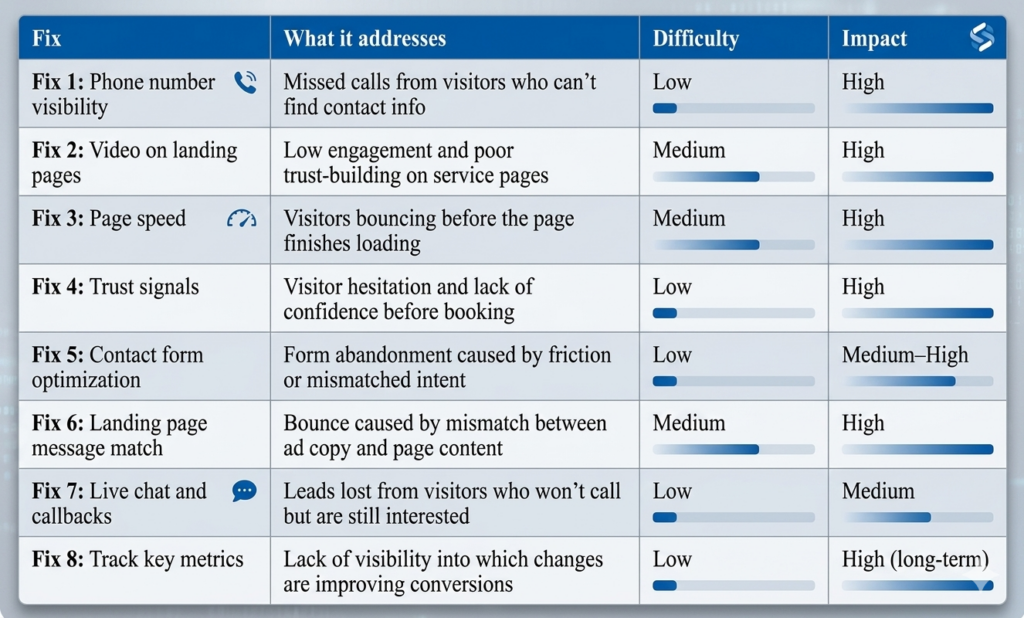
The table below summarises all eight fixes, what each addresses, how complex it is to implement, and the conversion impact you could expect if you get it right.
| Fix | What it addresses | Difficulty | Impact |
|---|---|---|---|
| Fix 1: Phone number visibility | Missed calls from visitors who can’t find contact info | Low | High |
| Fix 2: Video on landing pages | Low engagement and poor trust-building on service pages | Medium | High |
| Fix 3: Page speed | Visitors bouncing before the page finishes loading | Medium | High |
| Fix 4: Trust signals | Visitor hesitation and lack of confidence before booking | Low | High |
| Fix 5: Contact form optimization | Form abandonment caused by friction or mismatched intent | Low | Medium–High |
| Fix 6: Landing page message match | Bounce caused by a mismatch between the ad copy and the page content | Medium | High |
| Fix 7: Live chat and callbacks | Leads lost from visitors who won’t call but are still interested | Low | Medium |
| Fix 8: Track key metrics | Lack of visibility into which changes are improving conversions | Low | High (long-term) |
FAQs
-
What is a good conversion rate for an HVAC website?
Most HVAC websites convert between 2% and 5% of visitors. Well-optimized sites, particularly those running targeted Google Ads campaigns with dedicated landing pages, could achieve conversion rates of 15% or higher on specific pages.
-
Why is my HVAC website getting traffic but no calls?
Traffic without calls usually points to one or more friction points in the visitor journey. Common causes include shabby landing page messaging or a general lack of trust signals.
-
Does video on a landing page actually improve conversions for HVAC businesses?
A video pitch delivers a higher conversion rate on HVAC landing pages when it’s structured around the visitor’s problem. From experience, video on the page increases page dwell time and lowers bounce rate.
-
How long does it take to see results from CRO changes?
Low-effort fixes like phone number placement, click-to-call formatting, and trust signal additions could show a measurable impact within two to four weeks on a site with steady traffic. The timeline generally depends on how much traffic your site receives.
-
Should I send Google Ads traffic to my homepage or a landing page?
Dedicated landing pages consistently outperform homepages for paid traffic in the HVAC industry. Sending traffic to dedicated landing pages helps ensure message match and delivers higher conversions.
Ready to find out where your website is losing leads?
The eight fixes in this guide cover the most common points in the HVAC visitor journey where conversions break down. Some, like phone number placement and trust signal additions, you can work through yourself in a day. Others, like landing page builds and page speed optimization, tend to move faster and produce cleaner results with professional support.
At Klutch Growth, we’ve helped HVAC businesses across the US turn underperforming websites into consistent lead generators, including a Miami HVAC client whose conversion rate increased by 761% after we rebuilt their site around the principles in this guide. If your website is getting traffic but not producing the calls and bookings your business needs, we’d like to take a look.
Get in touch with our team, and we’ll identify the specific conversion gaps on your site and walk you through what fixing them would look like.
Recent Posts

June 19, 2026