


Before You Go—Let’s Boost Your Leads!
Join our community of successful HVAC and Plumbing contractors who trust Klutch Growth to enhance their online presence.
Klutch Growth Blog
Google Ads for HVAC: Proven Strategies to Get Quality Leads in 2026
Over 1 billion people now use Google’s AI Mode every month, and their searches run three times longer than the keywords you bid on. A homeowner no longer types “AC repair near me.” They describe the whole problem in full sentences and let Google’s AI decide which businesses show up.
In this guide, we’ll walk you through how Google Ads works for HVAC in 2026, the AI shifts changing how homeowners find contractors, and the campaign strategies that turn those longer searches into booked jobs. Everything here is practical, so you can apply it to your campaigns right off the bat.
What Google Ads are (and why HVAC companies rely on them)
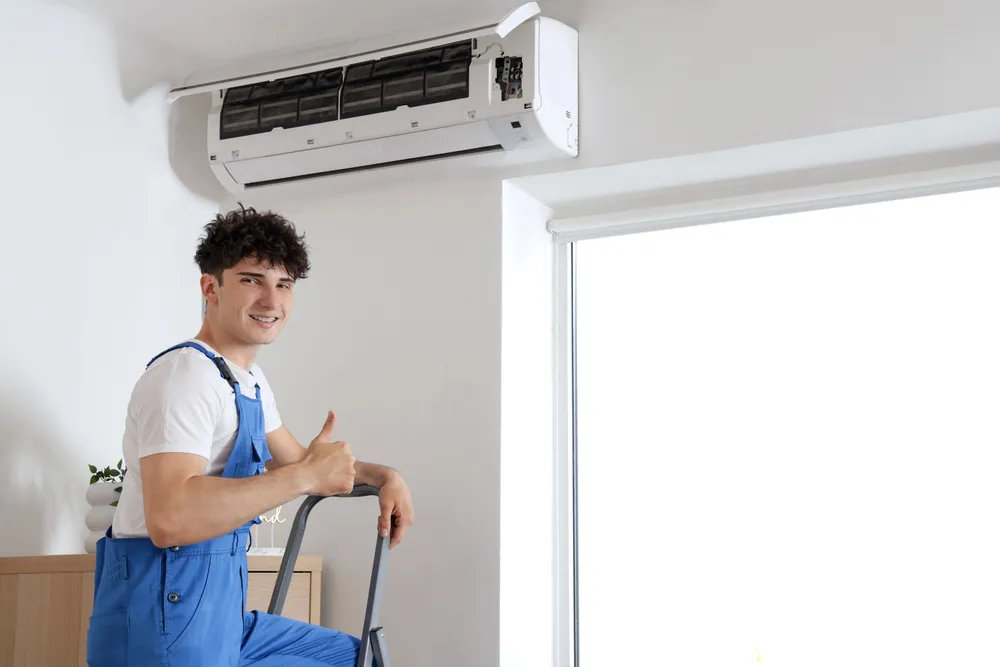
Google Ads is a pay-per-click platform that puts your HVAC business in front of customers at the exact moment they search for help. Before we get into the 2026 changes, let’s cover the fundamentals and why they still hold up.
What is Google Ads?
Google Ads works by bidding on searches related to your services, like emergency furnace repairs or AC installation. Your ad appears when a homeowner searches for those services, and you only pay when someone clicks. This makes it one of the most cost-effective ways to reach local customers who already need what you offer. That makes it one of the most cost-effective ways to bring in local HVAC leads.
Why Google Ads for HVAC Companies?
Google Ads delivers instant visibility while organic SEO builds over months. HVAC demand is also urgent by nature, since a homeowner with a dead furnace in January or a failing AC during a Miami heatwave wants help today, and ads put your number in front of them right away. You control the budget, track every conversion, and adjust campaigns in real time.
Is Google Ads still worth it for HVAC in 2026?
Yes, and the case is stronger than it was a few years ago. Google’s Marketing Live 2026 report notes that search queries reached an all-time high last quarter, which means more homeowners are searching and asking longer, more detailed questions. So the demand is there, and a single booked installation can return many times what you spend on the clicks that won it.
How AI changed the way homeowners search for HVAC services
The biggest shift since this guide was first published is how people search. Google has rebuilt Search around AI Overviews and AI Mode, and that changes what a winning HVAC campaign looks like. Here’s what’s different and how you can respond.
-
AI Mode and the rise of longer searches
AI Mode lets homeowners have a back-and-forth conversation with Search instead of typing short keywords. According to Google’s report, these AI Mode queries are three times as long as traditional searches. This means a homeowner might describe a humming condenser, a warm living room, and a weekend repair timeline all in a single search, and Google’s AI works out who can solve that exact problem.
-
What this means for your keyword strategy
Your keyword list still matters, but it captures less of the picture on its own. Google’s AI now matches ads to intent across long, conversational queries, so campaigns built only on exact phrases like “AC repair Miami” miss searches that describe the same problem in different words. The fix is to pair your core keywords with Google’s AI-powered campaign tools, which we cover later in this guide.
-
How to show up in AI search
Google’s own guidance for the AI era comes down to three moves. Lead with what only your business can say, focus on genuinely helpful content, and make your business agent-ready. For an HVAC company, this means publishing real service details, transparent pricing ranges, licensing information, and customer reviews, so Google’s AI has the substance it needs to present you as the answer.
Different types of Google Ads you can use
Choosing the right ad type shapes everything else in your campaign. In 2026, you have four main options, and each one earns its keep in a different way. Here’s how they break down for HVAC contractors.
1. Google Search Ads
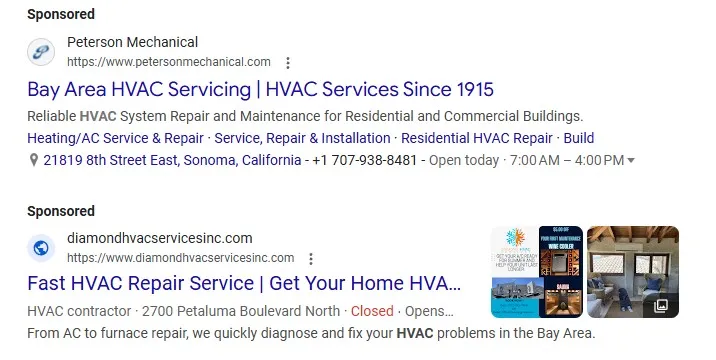
Search Ads appear at the top of Google’s results when homeowners search for services like HVAC repair or AC installation. You bid on keywords to reach high-intent customers, then drive them toward a call or a booking page. These remain the workhorse for capturing urgent leads.
2. Google Display Ads
Display Ads use visuals on websites and apps across the Google Display Network, reaching homeowners while they browse related content. They work best for brand awareness and for retargeting visitors who checked your site but didn’t book. Set a firm budget and use clean images of your trucks, techs, and completed jobs.
3. Google Local Service Ads for HVAC
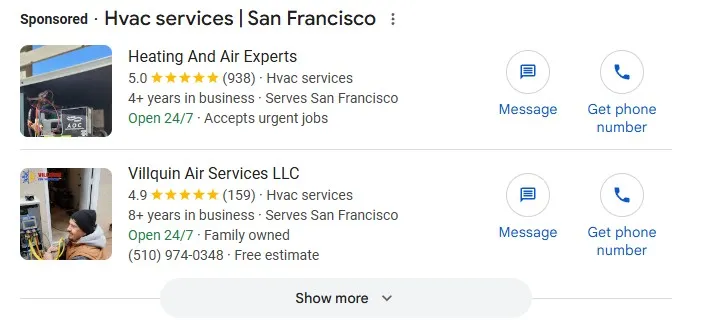
Local Service Ads (LSAs) show your business above the regular search results with a Google Guaranteed badge, which builds trust before anyone clicks. You pay per verified lead instead of per click, and Google vets your licensing and insurance to qualify you. We walk through the full setup later in this guide.
4. AI-powered ad formats
Google is now bringing ads directly into AI Mode and other AI Search experiences. Direct Offers reach high-intent customers with something special at the exact moment they’re ready to buy, and new agentic ads built with Gemini let a homeowner chat with your ad to qualify themselves before they ever call you. Google’s framing in its 2026 report is that the best ads in this era are simply answers, which suits HVAC perfectly because a homeowner with a broken system is only looking for one thing.
How to set up a Google Ads campaign for HVAC
If you’re starting from scratch, the setup process hasn’t changed much on the surface. The difference in 2026 lies in how you handle keywords and bidding. Here’s the step-by-step path.
- Create a Google Ads account: Head to ads.google.com, sign up, and link the account to your business’s Google account. Set your billing details and time zone before anything else.
- Define your campaign goal: Choose “Leads” as your objective so Google optimizes for calls and form submissions. A Search campaign is the right starting point for HVAC.
- Set up geo-targeting: Narrow your audience to your actual service area, like Miami-Dade County or a 20-mile radius around your shop. This keeps your budget focused on homeowners you can reach.
- Choose your keywords: Focus on high-intent terms like “emergency HVAC repair (your city)” and “AC installation near me,” using Google Keyword Planner to gauge volume. Treat these as your foundation rather than the whole strategy, since Google’s AI will extend your reach into longer conversational searches.
- Craft compelling ads: Write clear, urgent copy like “24/7 AC Repair in (Your City). Call Now!” and add call and location assets to boost clicks. We cover ad structure in detail later in this guide.
- Set budget and bidding: Start with a daily budget you can sustain for at least a month, then use conversion-based Smart Bidding like “Maximize Conversions” from the start. Google’s AI bidding needs conversion data to learn, so the sooner it starts collecting, the faster your results improve.
- Launch and track: Set up conversion tracking for calls and form submissions before you spend a dollar, then review performance weekly. Tweak keywords, ads, and budgets based on what the data shows.
Using AI Max and Performance Max for HVAC campaigns
AI Max for Search and Performance Max are Google’s answer to the longer, messier ways homeowners now search. AI Max upgrades your Search campaigns to match conversational queries, while Performance Max runs your ads across Search, Maps, YouTube, and Display from a single campaign. We’ve seen what the right campaign structure can do, as one of our clients at Klutch Growth went from 3 Google Ads conversions to 190 within a month of us rebuilding their account.
-
What AI Max does for longer homeowner queries
AI Max serves relevant ads against long, specific searches that your keyword list could never cover one by one. Google’s 2026 report shares how Lufthansa Group used AI Max to match longer travel queries and increased conversion rate by 16% while boosting ROAS by 24%. The same logic applies to HVAC, where one campaign could now cover the hundreds of ways a homeowner might describe a failing AC.
-
Rethinking match types in the AI era
The old advice was to avoid broad match entirely, and that advice needs an update. Paired with Smart Bidding, broad match now uses Google’s AI to interpret intent, which could help you capture those conversational AI Mode searches that exact match misses. A sensible structure might keep exact and phrase match on your core money terms, like “AC repair Miami,” while testing broad match with Smart Bidding in a separate ad group you watch closely.
-
Why negative keywords still matter
Wider AI matching makes negative keywords more important, not less. Terms like “DIY,” “cheap,” “salary,” and “how to become an HVAC tech” can pull in clicks that will never turn into jobs. Review your search terms report weekly and keep feeding the negative list, because that’s what keeps the AI’s reach working for your budget instead of against it.
Tips to Get Better Results from Your HVAC Ads
Once your campaign is live, small adjustments compound into real gains. These are the habits that separate accounts that improve every month from accounts that stall.
-
Use every relevant ad asset
Add call assets, location assets, and sitelinks to your ads. They make your ad larger on the page and give homeowners a one-tap path to calling you.
-
Schedule ads around demand
Run your budget harder during the hours homeowners actually call, like early mornings and weekends during summer. Ad scheduling keeps your spend matched to your call capacity.
-
Lean into seasonal spikes
AC searches surge in a Miami summer and furnace searches climb when the first cold front hits up north. Plan budget increases ahead of your busy season instead of reacting to it.
-
Optimize for mobile
A homeowner with a broken AC is searching from their phone, so your ads and landing pages should load fast and make calling effortless. Click-to-call buttons earn their place here.
-
Adding YouTube and Demand Gen when you’re ready
Google’s 2026 report shows that adding Demand Gen to Search and Performance Max campaigns drives 10% higher ROAS and 12% higher sales effectiveness on average, and YouTube now reaches 91% of US adults. For most HVAC businesses this is a later-stage play rather than a starting point, but once your Search campaigns are profitable, Demand Gen could build the local brand recognition that makes every future click cheaper. The new Maps inventory for Demand Gen also makes the format friendlier for local service businesses than it used to be.
Getting Started with Local Services Ads (LSAs)
LSAs deserve their own setup walkthrough because they run on a different model from regular Google Ads. You pay per lead, not per click, and Google verifies your business before you can show up. Here’s the path.
Step 1: Confirm your eligibility
HVAC is a supported category in most US metros. Check availability for your area on the Local Services Ads page before you invest time in the application. Either way, you can still explore which option to go for between LSAs and Google Ads for your HVAC business.
Step 2: Complete the screening
Google runs background checks and verifies your license and insurance. Passing earns you the Google Guaranteed badge, which displays right on your ad and backs customer jobs with Google’s protection.
Step 3: Set your budget by leads
You set a weekly budget based on how many leads you want, and you only pay for valid leads. Start conservative, then raise the cap once you trust your close rate.
Step 4: Stack up reviews
Review count and rating heavily influence your LSA ranking. Ask every satisfied customer for a Google review, and respond to the ones you get.
Step 5: Dispute junk leads
Wrong numbers, spam, and out-of-area calls can be disputed for credit. Audit your leads weekly so you only pay for real opportunities.
Extra tips
- If you use a scheduling tool or CRM, connect it. That way you can track leads from the first call to the finished job.
- Check your leads often. Dispute anything that looks fake or not relevant.
- Focus budget on areas that bring high value jobs. Some zip codes or neighborhoods are better than others.
- Rotate your offers with the season. AC in the summer, heating in the winter, indoor air quality in the off season.
How to build a strong HVAC ad that gets clicks
Google’s report points out that creative drives nearly half of incremental sales, which makes your ad copy the highest-leverage part of the whole account. Here’s how to get it right.
Write headlines that match the search
Your headline should mirror what the homeowner typed, so “AC Repair in Miami, Same-Day Service” beats a generic company tagline every time. Include your city, your core service, and one urgency or trust element. Numbers also pull clicks, like “Serving Miami Since 2009” or “4.9-Star Rated.”
Build trust in your descriptions
Use your description lines for proof, like licensing, guarantees, upfront pricing, and financing options. End with one clear action, such as “Call now for same-day service.” A homeowner choosing between three similar ads picks the one that feels safest.
Use Google’s new creative tools
Asset Studio now integrates Gemini and Veo, so you can generate and test professional ad assets in minutes instead of waiting on a designer. Small businesses also get Pomelli, a Google Labs tool built to create on-brand creative without a marketing team. The built-in one-click A/B testing means you could be testing three headline angles by this afternoon.
Pro Tips
- Add call extensions so customers can tap to call you right away.
- Use location extensions so your address shows in the ad. People are more likely to call when they see you’re local.
- Highlight extras like “Same Day Service” or “24/7 Availability” with callout extensions.
- Point clicks to the right page. If the ad is about furnace installation, don’t send them to a generic homepage. Send them to your furnace page.
Build your data strength to feed Google’s AI
Google’s report calls measurement the competitive engine fueling your AI, and that framing matters for HVAC. Every AI-powered feature in this guide performs only as well as the data you feed it. This is where most local campaigns quietly leak money.
Track calls and conversions properly
Set up conversion tracking for phone calls, form submissions, and booked jobs before you judge any campaign. Call tracking software assigns unique numbers to your ads, so you know exactly which keyword produced which call. Without this, Smart Bidding is learning from incomplete information.
Connect your first-party data
Google’s Data Manager and Google tag gateway let you connect your own customer data sources so campaigns get stronger signals. The report positions this as the foundation for growth for your HVAC business in the AI era, and the rewards of getting your data right compound quickly. For an HVAC business, even syncing your CRM’s closed-job data could sharpen who Google targets next.
Optimize for job value, not just leads
Google’s report features Dr. Martens feeding margin data into Performance Max to optimize for profitable sales instead of easy conversions. The HVAC version of this is assigning real values to your conversions, because a $99 tune-up and a $10,000 system replacement should not be worth the same to your bidding. Once Google knows which leads make you money, it goes and finds more of them.
What to Say in Your Ad Headlines
Crafting HVAC advertisements that grab attention starts with killer headlines. For air conditioning ads on Google Ads, your headlines (30 characters max each) must match user intent, solve problems, and drive clicks. Here’s how to make your ad headlines effective.
Match Search Intent
Use headlines like “Emergency AC Repair (City)” or “Fix Your AC Today!” to mirror urgency. For broader searches like “HVAC installation,” try “New AC Installed Fast.” Aligning with intent, as seen in search ad examples, boosts click-through rates.
Solve Problems
Highlight solutions to common HVAC pain points. For sweltering summers, use “Stay Cool with AC Repair!” or “Broken AC? Call Now!” For winter, try “Heater Not Working? Fixed Fast.” Problem-solving headlines resonate, especially for urgent needs like “24/7 Furnace Repair.”
Keep It Local and Specific
Include your city or area (e.g., “Tucson AC Repair”) to stand out in local searches. Numbers add punch, think “$99 AC Tune-Up” or “20+ Years HVAC Pros.” Specificity builds trust and fits air conditioning ads’ character limits.
Use Action Words
Start with verbs like “Fix,” “Call,” or “Book” to spur action. Examples: “Book Your AC Fix Today!” or “Call for Same-Day HVAC.” Avoid fluff like “Best HVAC”; instead, focus on benefits: “Fast, Reliable AC Service.”
Test and Tweak
Run two versions if you can. Let’s say:
- Version A: “Emergency AC Repair [City]”
- Version B: “Cool Your Home Fast!”
Use Google Ads data to see which one earns clicks, then tweak from there.
Improving Quality Score, Landing Pages, and CTA
Quality Score is Google’s rating of how relevant your keyword, ad, and landing page are to each other. A higher score boosts HVAC website conversion optimization, lowers your cost per click, and wins you better positions, so the work below pays for itself.
-
Keep your ads and keywords tightly themed
Group keywords into small, focused ad groups so every ad speaks directly to the search that triggered it. A homeowner searching “ductless mini split installation” should see an ad about mini splits, not a generic HVAC ad. Tight theming lifts clickthrough rate, which lifts Quality Score.
-
Build landing pages that convert
Send each ad to a dedicated page that delivers exactly what the ad promised, with your phone number visible before scrolling. Add reviews, your license number, and service-area details to settle trust questions fast. Pages should load quickly on mobile, since that’s where urgent HVAC searches happen.
-
Make the next step obvious
Every page gets one primary call to action, whether that’s a click-to-call button or a short booking form. Three fields beat ten, because a homeowner sweating in a hot house won’t fill out a questionnaire. Test your own form on a phone and count the taps it takes to reach you.
Tools You Can Use to Track Leads and ROI
To make your HVAC advertisements pay off, you need tools to track leads and measure ROI effectively. Using dynamic call tracking and conversion tracking, you can optimize leads and optimize ad spend for your HVAC business.
Dynamic Call Tracking
Tools like CallRail or CallTrackingMetrics use dynamic call tracking to assign unique phone numbers to each ad, keyword, or campaign. When a customer clicks your HVAC ad (e.g., “AC repair [City]”) and calls the number on your landing page, the tool traces the call back to the specific ad or keyword.
Conversion Tracking
In Google Ads, set up conversion actions for calls via call extensions or website calls. Use Google’s forwarding numbers or third-party tools to log calls lasting over a set duration (e.g., 60 seconds) as conversions.
Measuring ROI
Calculate cost per lead (CPL) and cost per booked job. Example: $500 ad spend yields 100 clicks ($5 CPC), 10 calls ($50 CPL), and four bookings (40% conversion, $125 per job). If each job averages $1,000, ROI is ($4,000 – $500) / $500 = 700%.
Using Software and Automation to Get More From Ads
To maximize your HVAC advertisements and book jobs quickly, leveraging software and automation tools is a must. These tools streamline your ad optimizer efforts.
CRMs for Lead Capture
Tools like ServiceTitan and Housecall Pro are game-changers for HVAC businesses. ServiceTitan automates lead capture from Google Ads. Housecall Pro offers similar functionality, with online booking forms and call tracking to capture leads instantly.
Ad Optimizers
Platforms like Market Wiz AI and LeadLifter act as ad optimizers, fine-tuning your campaigns. Market Wiz AI uses AI-driven insights to adjust bids, target high-intent keywords like “emergency AC repair [City],” and A/B test ad copy for better click-through rates.
Google Business Profile Integration
Link your Google Business Profile to your CRM and ads for seamless lead tracking. Automated review requests post-service boost your profile’s visibility, driving more clicks from local searches.
Common Challenges and Mistakes to Avoid
We’ve audited a lot of HVAC ad accounts over the years, and the same problems show up again and again. Check your campaigns against this list before you blame the platform.
- Sending clicks to your homepage: A homepage makes visitors hunt for what they searched for. Dedicated landing pages convert better and raise your Quality Score.
- Neglecting negative keywords: Skipping your search terms report means paying for DIY researchers and job seekers. A weekly review keeps wasted spend in check.
- Setting and forgetting campaigns: Google Ads rewards accounts that adapt to HVAC seasonality, new competitors, and shifting costs per lead. A monthly deep review is the minimum.
- Spreading budget too thin: Running ten services on a small budget means none of them get enough data to optimize. Start with your two or three most profitable services and expand from there.
- Writing ads only for short keywords: Homeowners now describe full problems in conversational searches, so copy built around two-word phrases misses how they speak. Write ads that read like answers to real questions.
- Running AI bidding on weak data: Smart Bidding and Performance Max learn from your conversion tracking, so feeding them incomplete or untracked data produces expensive guesses. Fix your measurement first, then hand the AI the keys.
Final Thoughts on Running Google Ads for HVAC
The fundamentals of Google Ads haven’t moved. Homeowners still search with urgent intent, and the businesses that show up with the right answer still win the job. What’s changed is the machinery underneath, because Google’s AI now decides which ads answer those longer, more detailed searches.
Your job is to feed that AI well. That means clean conversion tracking, connected first-party data, ad copy that works as an answer, and campaign tools like AI Max that are built for how people search now. The HVAC companies that adapt to this early could lock in an advantage their competitors will spend years chasing.
If you’re ready to put in the time or work with a digital marketing agency that specializes in Google Ads for HVAC, they can keep your phone ringing and your funnel full. Start small, test, and scale up as you go.
Recent Posts

August 31, 2026

June 19, 2026
