


Before You Go—Let’s Boost Your Leads!
Join our community of successful HVAC and Plumbing contractors who trust Klutch Growth to enhance their online presence.
Klutch Growth Blog
How to Rank for “Near Me” Keywords: A Local SEO Guide
Most local businesses have no idea how to rank for near me keywords. Strange, because these are the searches that turn into jobs the fastest.
People don’t type “AC repair near me” for fun. They’re stuck. Something broke. They need help right now.
Google calls this “immediate intent.” And the numbers back it up.
According to Google’s local conversion statistics, 76% of people who search for something nearby visit a business within a day. 28% make a purchase. That’s real money on the table.
Yet many contractors still pour everything into Google Ads or social posts. Meanwhile, the searches with the highest buying intent slip right past them. No optimization. No local signals. Nothing that tells Google, “Yes, we can take this job.”
If you learn how to rank for near me keywords, you don’t just get more traffic. You get high-intent calls from people who are ready to hire the moment they see your name.
This guide breaks down how to build that visibility, step by step, without looking spammy or triggering Google’s filters.
Let’s get into it.
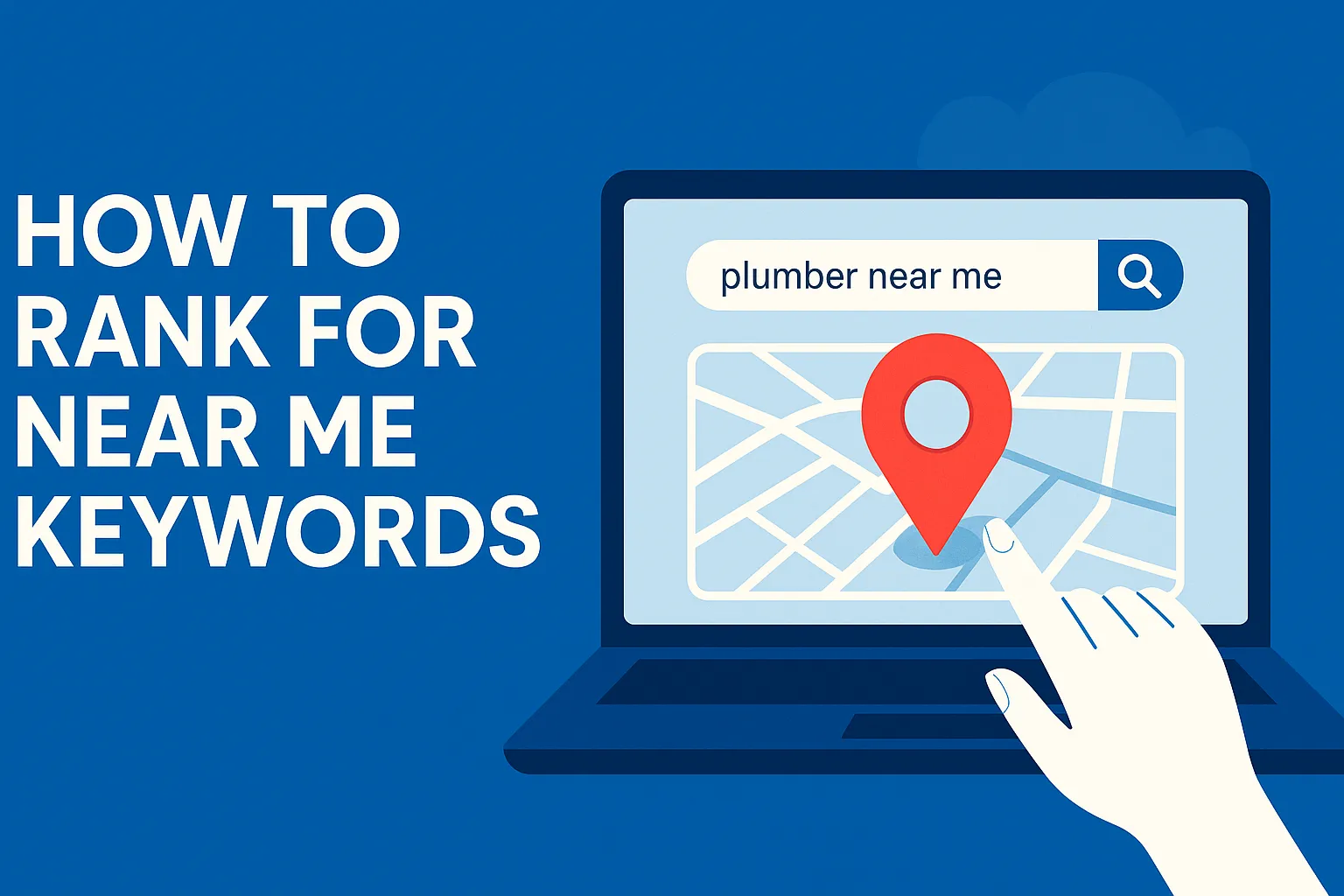
What Are “Near Me” Searches and Why They Matter
“Near me” searches happen when someone adds location-based terms to their Google query, either explicitly by typing “plumber near me” or implicitly by searching “emergency AC repair” while Google detects their location. These searches have surged in recent years as mobile devices became the primary way people look for local services.
Local intent is now a major part of search behavior. Almost half of all Google searches involve someone trying to find a nearby business or service. That matters for HVAC and plumbing companies because these users usually have an urgent issue and want help fast.
The urgency factor makes all the difference. When someone searches “furnace repair near me” at 7 AM on a January morning, they’re not comparing quotes. Their heat is out. They’re cold. They need a technician today. This type of intent converts far better than broad, generic searches.
Mobile usage also pushes “near me” searches higher. Most people search from their phones, and voice assistants like Siri and Google Assistant automatically use location to return nearby options. It’s one tap to call or book, which is why mobile-driven local searches turn into real leads quickly.
How Google Interprets “Near Me” Keywords
Google doesn’t treat “near me” searches the same way it handles other keywords. Near me searches use a different algorithm for which weighs location and business profiles above traditional SEO content. Understanding these ranking signals can give you a massive advantage in capturing local traffic in your service area.
Local Ranking Factors
Google evaluates local businesses based on three primary factors: relevance, distance, and prominence. These aren’t weighted equally, and the balance shifts depending on the specific search and user context.
Relevance measures how well your business matches what the searcher wants. If someone searches “AC repair near me,” Google looks at your business category, services, and website content to determine if you actually provide air conditioning repair.
The distance factor considers how close you are to the searcher or the area they specify. For service area businesses like HVAC and plumbing contractors, Google looks at your defined service areas and considers which businesses can realistically serve the searcher’s location.
Prominence evaluates your overall authority and reputation. This combines traditional SEO factors like website authority with local signals like review quantity and quality, citation consistency, and how often your business gets mentioned online.
Signals Google Uses
Google’s local algorithm pulls data from multiple sources to understand your business and rank you appropriately for “near me” searches. The search engine combines device signals, user behavior data, and business information to make ranking decisions.
Device GPS and location awareness form the foundation. When someone searches on their mobile device, Google uses their IP to estimate location and can show businesses within a reasonable distance. This creates opportunities for businesses in smaller towns or less competitive areas to rank higher than larger companies located farther away.
Personalization also influences results. If someone previously visited a specific HVAC company’s website or called them from Google search results, that business might rank higher in future “near me” searches from the same user.
Where “Near Me” Queries Show Up
“Near me” searches trigger different types of results depending on the query and user context. Understanding these result types helps you optimize for the right opportunities.
Google Maps captures the majority of mobile “near me” searches. Google often shows the Maps interface with nearby businesses, contact information, and directions. Rankings here depend heavily on Google Business Profile optimization and proximity.
Then the Local Pack comes next that blends informational and local intent. This is the box showing three businesses with reviews, hours, and contact information.
Lastly, “near me” searches bring up conversational AI and Google SGE (Search Generative Experience) answers. The key insight here is that search engines try to predict which businesses will provide the best experience for that specific searcher in their specific situation.
How to Rank for “Near Me” Keywords Without Looking Spammy
Getting found in “near me” searches requires a strategic approach that balances optimization with authenticity. Google’s algorithm has become sophisticated enough to detect and penalize businesses that try to game the system with keyword stuffing or fake signals. The businesses that rank consistently follow specific best practices that build genuine local authority.
Optimize your Google Business Profile (GBP)
Your Google Business Profile serves as the foundation for all “near me” rankings. Google uses your GBP data to determine when and how to show your business in local search results. You can start your optimization by curating an accurate list of services and categories. Of course, you have to choose the broader service as your primary service. Then, proceed to add secondary services that reflect your adjacent offerings which helps your business profile stand out.
The next stage of your optimization is choosing your service areas. In this section, just like with the previous, ensure to leave no stone unturned. But also be careful not to claim areas you can’t realistically serve. If your downtown Miami HVAC repair doesn’t extend to Fort Lauderdale, then don’t include it unless you’re willing to actually travel that distance. Alongside these key details, also ensure to fill up every field in your GBP. Business hours, phone numbers, website links, and service descriptions all factor into ranking algorithms.
Pro Tip: You can also make regular updates on your GBP and ensure to add location keywords. You can GBP posts about current promotions, seasonal services, or recent projects. One post about “furnace tune-ups before winter hits Dallas” can help you rank for “furnace maintenance near me” searches in that area.
Build Reviews and Social Proof
Google treats reviews as signals of both quality and legitimacy, especially for searches with immediate need like “emergency plumber near me.” You need to build a system that helps you generate customer reviews on the go. So, for every excellent work you complete, it should uplift your local business profile.
Also ensure you respond to all your reviews, both positive and negative. A thoughtful response to a negative review often helps your ranking more than ignoring it. You also need consistent, recent reviews that mention specific services and locations, so encourage that from your clients.
Local Search Optimization
There are other ways to position your business for better visibility locally, and one is to create service pages for each major location you serve. Google often pushed pages that carry both the specific service and the location in their title and metadata towards near me searches.
Build Citations and Directory Listings
Get your business mentioned in as many industry-relevant directory listings as you can find. These citations which typically mention your business name, address, and phone number help add legitimacy and credibility to your business. Only ensure that your NAP (Name, Address and Phone) are consistent across board.
Mobile and Voice Search Readiness
Optimizing for mobile and voice search helps you capture the bulk of near me search traffic which happens via these channels. The strategies involved here are enabling mobile responsiveness for your website and keeping your content relatable and conversational. The natural tone in your website content and GBP posts helps voice search AI like Siri and Alexa to pick your website as a viable service provider for local searchers.
Advanced “Near Me” SEO Strategies
Once you’ve mastered the fundamentals, advanced strategies can help you dominate “near me” searches in competitive markets. These techniques require more effort but create sustainable competitive advantages.
Create Hyperlocal Content Campaigns
Hyperlocal content targets specific neighborhoods, districts, or communities within your service area. This strategy helps you capture “near me” searches from people in those specific locations. You can write blogs about seasonal issues in specific neighborhoods in your service area. As a Miami HVAC contractor, you can publish articles on “Preparing Coral Gables homes for hurricane season: AC maintenance checklist” or “Why Brickell Avenue condos need special HVAC considerations.”
Hyperlocal content helps you rank for location-specific searches while demonstrating local expertise. Before and after photos from specific neighborhoods, with customer testimonials mentioning the location, are also powerful local signals. Another angle is to partner with other local businesses to create content together like podcasts or a featured post which can help you create natural backlinks from locally relevant sources.
Leverage Influencer and Local Media Mentions
Local authority signals carry significant weight in “near me” rankings. Building relationships within your community creates citation opportunities that competitors can’t easily replicate. Many cities have bloggers, reporters or social media personalities focused on local real estate, home improvement, or lifestyle content. Offering your expertise for their content can help you nab some valuable local mentions.
Multi-location “Near Me” Targeting
If you serve multiple cities or have several locations, you need a coordinated strategy to capture “near me” searches across your entire service area. Start by creating dedicated landing pages for each major service area. Then, gradually build comprehensive resources for each location, including local contact information, specific services relevant to that area, and content addressing local concerns.
You can then implement internal linking strategies between these location pages. Connect related service areas logically using hyperlinked texts like: “We also provide emergency plumbing services in nearby Fort Lauderdale and West Palm Beach.” This helps both search engine crawlers and users to find more relevant information about your service coverage.
AI and Future of “Near Me” Searches
Search technology continues evolving, particularly with AI-powered features like Google SGE and improved voice assistants. You can optimize your content for conversational AI queries by ensuring your GBP description and website content can be read out naturally in sentences spoken by voice assistants. Also, having well-structured, authoritative content increases your chances of being featured in these AI responses. You can also use the burrow down strategy which curates consistent mentions of your business in connection with specific services and locations to help AI systems recognize your expertise and recommend you appropriately.
How to Track Performance of “Near Me” Keywords
Measuring “near me” SEO success requires different metrics than traditional SEO campaigns. You need to track both visibility improvements and business impact to understand what’s working and justify your optimization efforts.
GBP Insights
Google Business Profile provides the most direct data about your “near me” search performance. These insights show exactly how customers find and interact with your business through local search. You can track calls, direction requests, and website clicks separately. Each action type reveals different aspects of your local search performance. GBP insights also show which terms people used to find your business. Look for patterns in “near me” variations and location-specific searches. If you’re showing up for “AC repair Miami” but not “emergency AC repair near me,” you know where to focus optimization efforts.
Then, analyze seasonal trends in discovery searches. HVAC and plumbing businesses see predictable seasonal patterns in “near me” searches. Track how your visibility changes during peak seasons (summer for AC, winter for heating, spring for plumbing issues after freeze damage). That means you can expect to double down your optimization efforts during these periods.
Local Rank Tracking
There are certain SEO tools that are designed for local search tracking. Local Falcon, BrightLocal, and Whitespark provide location-specific ranking data that reflects real “near me” search results. You can set up tracking for multiple locations within your service area with these tools. You can also track your rankings for different device types and search intent to understand your most productive angles. Maybe also identify which competitors appear most frequently in “near me” results for your target keywords and reverse engineer some of their standout areas.
Conversion Tracking
The ultimate measure of “near me” SEO success is business impact. You need systems to connect local search visibility improvements to actual revenue and customer acquisition. First, add UTM parameters to all GBP links. Tag your website links in Google Business Profile with UTM parameters like “utm_source=google&utm_medium=local&utm_campaign=gbp” to track which traffic comes from local search interactions.
Second, implement call tracking for phone numbers. You can try using different phone numbers for your website versus your GBP listing and citations to measure which source generates more calls. This data helps you understand whether people prefer calling directly from search results or visiting your website first.
Then, track form submissions by traffic source. Set up goal tracking in Google Analytics to measure how many people complete contact forms after finding you through “near me” searches. Compare conversion rates between local search traffic and other sources.
Connect “Near Me” SEO to Real ROI
You can calculate your revenue per “near me” search conversion. If emergency plumbing calls average $400 per job and your “emergency plumber near me” optimization generates 20 additional calls monthly, that’s $8,000 in direct attributable revenue. Use this data to demonstrate ROI and guide budget decisions.
Track customer lifetime value from local search customers. Local search customers often become repeat customers and refer others in their neighborhood. Measure the long-term value of customers acquired through “near me” searches compared to other marketing channels.
Monitor market share in local search results. Calculate what percentage of total “near me” search volume you’re capturing compared to competitors. If there are 1,000 monthly searches for “HVAC repair near me” in your area and you’re visible for 300 of them, you have a 30% local search market share.
Common Mistakes in “Near Me” SEO
Many businesses sabotage their “near me” rankings through well-intentioned but misguided optimization efforts. Avoiding these common mistakes protects your local search visibility and prevents Google penalties.
Keyword Stuffing “Near Me” Phrases Unnaturally
Writing content like “We are the best plumber near me for all your plumber near me needs” looks spammy and hurts rankings. Google’s algorithm recognizes natural language patterns and penalizes obvious keyword manipulation. Write for humans first, search engines second.
Ignoring Negative Reviews or Responding Defensively
A single angry review won’t destroy your rankings, but ignoring customer complaints or responding defensively signals poor customer service to both Google and potential customers. Address negative reviews professionally and offer solutions publicly.
Using Inconsistent Business Information Across Platforms
Your business name, address, and phone number must match exactly across your website, Google Business Profile, and all citation sources. “Smith Plumbing” versus “Smith Plumbing LLC” confuses Google’s data matching algorithms and dilutes your local authority signals.
Creating Thin or Duplicate Service Area Pages
Copying the same content across multiple location pages and just changing city names provides no value to users and may trigger duplicate content penalties on Google search rankings. Each location page should offer unique, locally relevant information.
Claiming Service Areas You Can’t Realistically Serve
Don’t claim you serve areas where you can’t provide timely, quality service. Customer complaints about poor service or long wait times in claimed service areas hurt your overall local search authority.
Neglecting Mobile Optimization for Emergency Searches
Most “near me” searches happen on mobile devices, often during urgent situations. If your website doesn’t load quickly or display properly on mobile, you’ll lose potential customers even if you rank well.
Focusing Only on Rankings Instead of Conversions
Ranking #1 for “plumber near me” means nothing if your listing doesn’t convert searchers into customers. Optimize for both visibility and conversion by focusing on compelling business descriptions, accurate hours, and clear contact information.
FAQs on “near me” SEO
Should I use “near me” keywords directly on my site?
Use “near me” variations naturally in your content, but don’t keyword stuff them. Google understands location intent from context. Writing “When Dallas residents need emergency HVAC repair” works better than repeating “HVAC repair near me” multiple times.
Can service businesses rank without a storefront?
Yes, but you need a clearly defined service area and consistent NAP information. Use your home office address or registered business address for Google Business Profile, but hide the address if customers don’t visit your location.
What’s more important — reviews, proximity, or keywords?
It depends on the competition and search context. In highly competitive markets, reviews and overall prominence matter most. For emergency searches, proximity often trumps other factors. Keywords help Google understand relevance but won’t overcome poor reviews or distant locations.
How do I target multiple cities with “near me” optimization?
Create separate, comprehensive pages for each major service area with unique content addressing local needs. Include local contact information, area-specific services, and content that demonstrates knowledge of each location.
How long does it take to rank for “near me” keywords?
Local SEO typically shows initial results within 2-3 months for less competitive keywords and markets. Competitive terms in major cities might take 6-12 months of consistent optimization. Emergency-related searches often see faster results because there’s less content competition.
Do I need separate websites for different locations?
Generally no. One well-organized website with dedicated location pages works better than multiple separate sites. Use subdirectories like yoursite.com/dallas-hvac-repair for different service areas instead of separate domains.
Final Thoughts: Turning “Near Me” Searches into Local Leads
Ranking for “near me” keywords isn’t just about visibility. You’re targeting customers with immediate intent who need your services right now. This makes local search optimization one of the highest-ROI marketing strategies for HVAC and plumbing businesses.
The fundamentals matter most. A complete, accurate Google Business Profile with consistent citations and genuine customer reviews will outperform flashy tactics every time. Your number one goal must always remain providing excellent service that naturally generates positive reviews and local word-of-mouth referrals.
Remember that emergency intent drives most “near me” searches in your industry. When someone’s AC fails during a Miami heatwave or their pipes burst on a freezing Dallas morning, they’re not price shopping. They need reliable, fast service from a nearby contractor. Make sure your online presence communicates reliability, availability, and local expertise.
The investment in “near me” SEO compounds over time. Each positive customer interaction creates reviews, referrals, and local authority signals that improve your rankings for future searches. This creates a sustainable competitive advantage that’s difficult for competitors to replicate.
Is your business losing qualified leads to competitors who understand local search optimization?
We help HVAC and plumbing businesses dominate “near me” searches through strategic Google Business Profile optimization, citation building, and local content development. Schedule a free local SEO audit to discover exactly which high-conversion “near me” keywords you’re missing and how to capture them. Our analysis shows you the specific optimization opportunities in your market and provides a roadmap for generating more local leads within 90 days.
Recent Posts

August 31, 2026

June 19, 2026