


Before You Go—Let’s Boost Your Leads!
Join our community of successful HVAC and Plumbing contractors who trust Klutch Growth to enhance their online presence.
Klutch Growth Blog
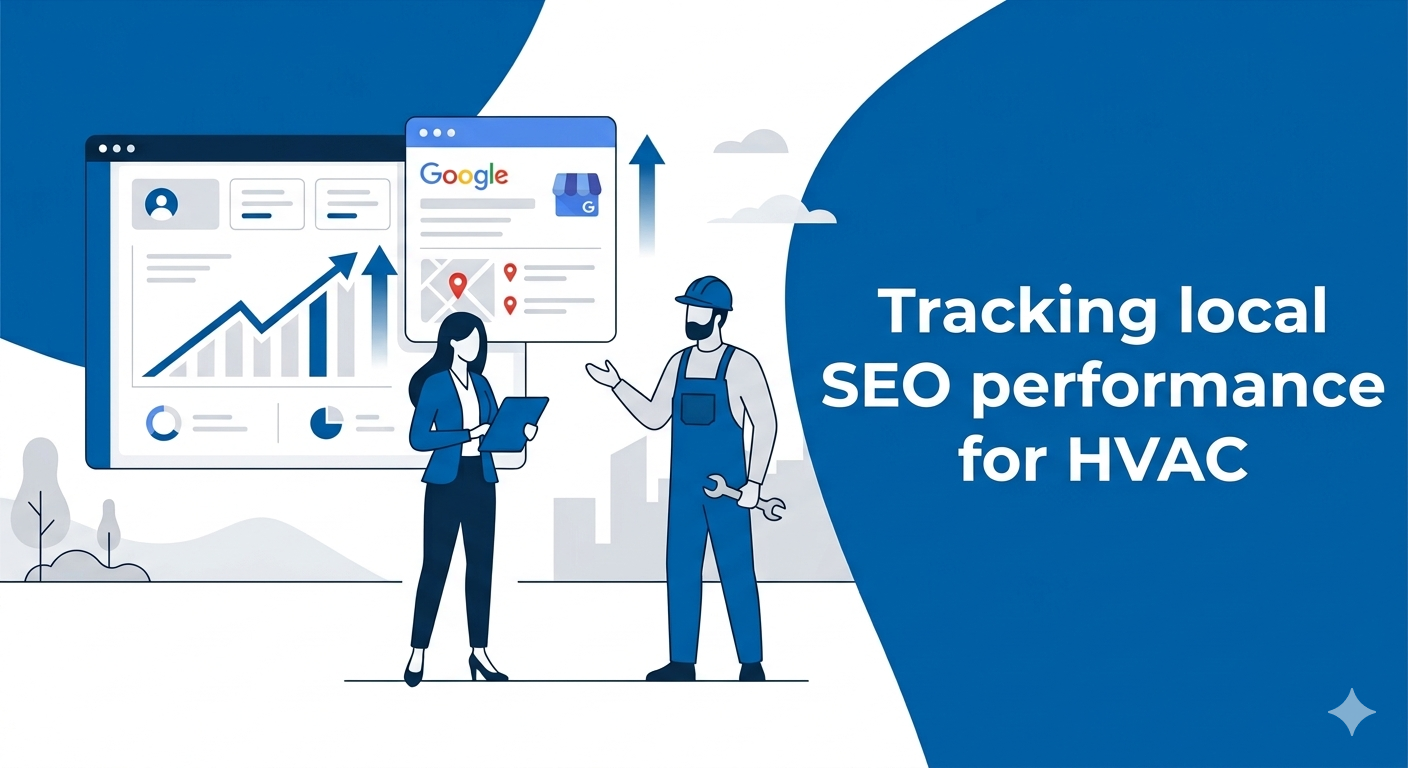
Tracking local SEO performance for HVAC
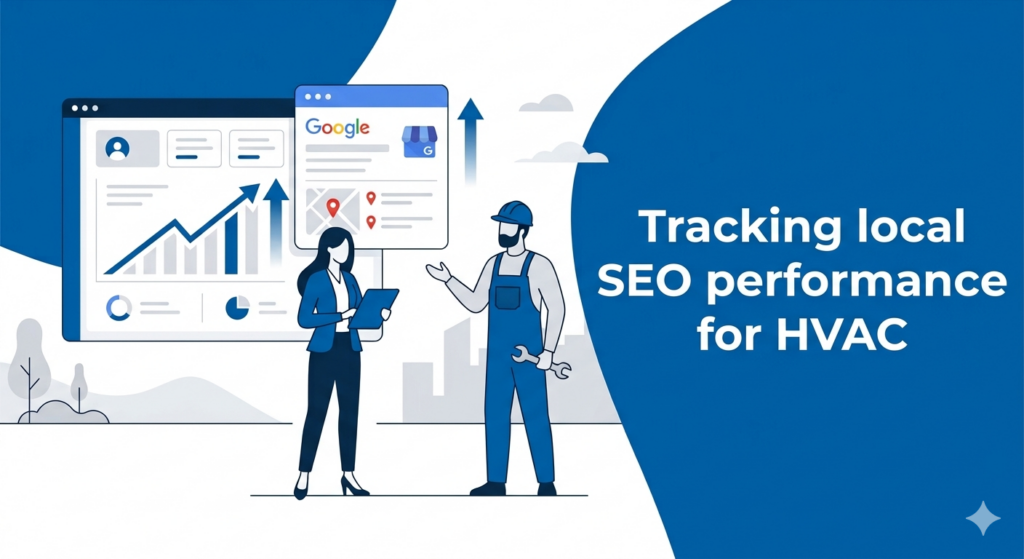
Tracking local SEO performace for HVAC
The real problem with tracking local SEO performance for HVAC businesses is that most owners don’t know which metrics matter most.. Tracking the wrong things is just as frustrating as tracking nothing at all. According to a 2023 survey, 72% of marketers and business owners either struggle to get insights from their data or don’t understand the data they’re already looking at.
We’ve seen this pattern up close. One of our clients, a Miami-area HVAC business, came to Klutch Growth with the same blind spot. After we rebuilt their citation profile and optimized their Google Business Profile, they saw a 130% increase in lead generation over three months. The difference wasn’t just the work. It was knowing which numbers to move.
This article gives you a practical framework for tracking local SEO the right way. We’ll cover which metrics actually connect your SEO effort to calls, leads, and booked jobs, and what to do when the numbers aren’t moving.
Why most HVAC owners can’t tell if their SEO is actually working
-
The activity vs. outcome trap
There’s a difference between activity metrics and outcome metrics. Activity metrics include things like keywords targeted, blog posts published, and citations submitted. Outcome metrics are the ones that actually matter. Things like calls from Google, Map Pack appearances, leads converted into booked jobs.
-
The reporting gap
Standard monthly PDF reports tend to include vanity metrics. Domain authority scores, backlink counts, and keyword rankings are all real data points, but none of them tell you whether a homeowner picked up the phone. What’s usually missing from these reports are call volume from your Google Business Profile, direction requests, website clicks from local search, and how those numbers trend over time.
-
Why HVAC makes this harder
Seasonal demand complicates attribution in ways that most other industries don’t deal with. A spike in calls in July could be summer AC demand, an improved GBP, stronger rankings, or all three at once. Without the right tracking in place, you’re guessing.
Service area businesses add another layer of complexity. Your Map Pack visibility shifts depending on where the searcher is located within your service area. A business ranking #1 near their physical address might drop to #5 for homeowners across town. Most reports don’t capture that.
The metrics that actually tell you something useful
Not every number in your SEO dashboard is worth your attention. These are the metrics that actually connect your local SEO work to real-world outcomes for an HVAC business.
-
Google Business Profile insights
Your Google Business Profile (GBP) Insights dashboard shows how customers are finding and interacting with your profile. The most important distinction is between direct searches (someone typed your business name) and discovery searches (someone searched “HVAC repair near me” or “AC installation Miami”). For most HVAC businesses, discovery searches are the ones that matter most. They represent homeowners who didn’t already know you existed.
The four metrics worth monitoring closely are search impressions, call clicks, website clicks, and direction requests. These are the closest proxy to actual customer intent available in your GBP dashboard. Impressions tell you how often your profile appeared. The other three tell you what people did after they saw it.
The benchmark to watch is direction requests and call clicks trending upward month-over-month. That movement is a stronger signal of real progress than raw impression counts alone.
-
Local search rankings (Map Pack vs. organic)
What most ranking reports miss is that your Map Pack position isn’t fixed. It shifts based on the searcher’s proximity to your business address. You might rank #1 for someone a mile away and #6 for someone across your service area. A single average ranking number doesn’t capture that. Geo-grid tracking tools like Local Falcon or BrightLocal map your visibility across a defined grid of your service area, which gives you a much more accurate picture of where you’re winning and where you’re not.
What to look for over time includes steady improvement in Map Pack positions across your core service area, and for which search terms you’re appearing. High-intent queries like “AC repair [city]” or “emergency HVAC near me” matter more than broad informational terms.
-
Website traffic from local searches
Google Search Console (GSC) shows which search queries are bringing people to your website, how many clicks those queries produce, and the average position you’re ranking in. It’s one of the most underused free tools available to local businesses.
For HVAC, the most useful filter is by location and query type. Look specifically for two patterns, which are high-impression, low-click queries where you’re ranking but your title or meta description isn’t compelling enough to earn the click, and the split between branded queries (your business name) and non-branded queries (service + city). Non-branded click growth is a strong indicator that new customers are finding you through local search.
Google Analytics 4 (GA4) completes the picture. Where GSC shows how you’re found, GA4 shows what visitors do once they land on your site. Set up conversion tracking for call clicks, form submissions, and booking completions. Without that, traffic numbers are interesting but not actionable.
-
Call tracking and lead attribution
For HVAC businesses who are serious about converting traffic to booked jobs, phone call are still the most reliable method. If you can’t connect incoming calls to the source that generated them, you can’t measure what your local SEO is actually worth.
Call tracking tools can help you assign unique phone numbers to different traffic sources. When a customer calls the number on your GBP listing, you know that call came from local search. When they call the number on your website, you know it came from a web visit. Without that separation, revenue attribution is mostly guesswork, and owners often either over-credit SEO or dismiss it entirely because the connection to calls isn’t visible.
-
Citation accuracy and consistency
Local citations are your business name, address, and phone number (NAP) listed across directories like Yelp, Angi, Yellow Pages, and local chamber sites. Google uses consistency across these listings as a trust signal. Inconsistent citations, where your phone number is listed differently across platforms or an old address is still showing, can suppress your local rankings without any obvious cause.
Tracking citation health means checking that your NAP is consistent across all major platforms, that duplicate listings don’t exist, and that new citations are being built on authoritative sites over time.
What good performance actually looks like for an HVAC business
One of the most common frustrations we hear from HVAC owners is that they don’t know whether their numbers are good or just okay. That’s a fair question, and the honest answer is that ‘good’ depends heavily on your market. A business competing in Miami looks different from one in a mid-sized market with far less competition. Universal targets tend to mislead more than they help.
What we can do is give you a reliable framework for knowing whether you’re moving in the right direction.
-
Setting realistic baselines
Before you can judge progress, you need a starting point. Pull your current GBP metrics, note your Map Pack position across your core service area, and document your monthly call volume by source. That’s your baseline. Everything you measure from that point forward is compared against it, not against some industry average pulled from a blog post.
Most local SEO improvements take three to six months before they show up meaningfully in traffic and calls. Owners who check their numbers at 30 days and draw conclusions from what they see are almost always working with incomplete data. The trajectory matters more than any single month’s snapshot.
-
Signs your local SEO is gaining traction
These are the indicators that point to real, compounding progress rather than short-term fluctuation.
-
GBP discovery searches increasing month-over-month
When discovery searches trend upward, it means more homeowners who didn’t know your name are finding your business through service-based queries. That’s the core goal of local SEO. Direct search growth is fine, but discovery search growth is what expands your customer base.
-
Call clicks and website clicks from GBP trending upward
Look at these over a rolling 90-day window rather than month to month. Short-term dips happen for all kinds of reasons. A 90-day trend smooths out the noise and shows you whether engagement is genuinely building.
-
Map Pack position improving across your service area
Pay particular attention to visibility for high-intent queries like “AC repair [city]” or “furnace installation near me.” Ranking for those terms in more areas of your service zone means your GBP is earning trust in places it wasn’t reaching before.
-
Organic website traffic from local search queries growing
Watch for improving click-through rates on both branded and non-branded terms in Google Search Console. Non-branded click growth in particular signals that your content and local pages are pulling in new visitors, not just people who already know you.
-
Inbound call volume attributable to organic and GBP sources increasing
This is the metric that ties everything else together. Rankings, impressions, and traffic are all leading indicators. Call volume from local search is the outcome. When this number moves consistently in the right direction over a 90-day period, your local SEO is working.
Signs something isn’t working
Not every plateau is a waiting game. Some patterns point to a specific problem that needs attention rather than more time.
-
Rankings improving but call volume flat
This usually points to a conversion problem on your website rather than an SEO problem. Your rankings are doing their job by bringing visitors. Something on the site, whether it’s unclear calls to action, slow load times, or a poor mobile experience, is preventing those visitors from calling. That’s a different fix from anything SEO-related.
-
GBP impressions high but calls low
High impressions with low call clicks often means your profile is appearing for informational queries rather than high-intent ones. Someone searching “how much does AC repair cost” may see your profile without any intention of calling today. Review your GBP categories, services, and the search terms triggering your impressions to see whether you’re attracting the right kind of visibility.
-
Traffic increasing but no leads
If website sessions are climbing but form submissions and call clicks aren’t following, check these three things. Whether your pages have a clear and prominent call to action, whether your site loads quickly on mobile, and whether visitors are landing on pages relevant to what they searched for. Traffic without conversion is a UX problem, and it won’t be solved by more SEO work alone.
The tools you need to track these metrics
You don’t need an enterprise software stack to track local SEO performance well. Most HVAC businesses can get a clear, actionable picture of their local search health using a handful of tools, chief of which are completely free.
-
Google Business Profile Insights
This is built directly into your GBP dashboard and costs nothing. It tracks search impressions, call clicks, direction requests, and website clicks. Start here before adding anything else. GBP Insights gives you the most direct view of how real customers are interacting with your local presence, and the data updates regularly so you can spot trends without waiting on a third-party report.
-
Google Search Console
Also free. GSC shows which search queries are driving traffic to your website, your average ranking position for those queries, total impressions, and click-through rates. For HVAC businesses, the most useful view is filtering by location to isolate local query performance. Pay attention to queries where you have high impressions but low clicks. Those are ranking opportunities where a stronger page title or meta description could move the needle without any additional SEO work.
-
Google Analytics 4
Free, and pairs directly with GSC to complete the picture. Where GSC shows how visitors found you, GA4 shows what they did after they arrived. The most important setup step is configuring conversion events for call clicks, form submissions, and booking completions. Without that, GA4 just tells you people visited. With it, you can connect traffic sources to actual lead activity and start to see which pages and queries are generating revenue.
-
A call tracking tool (Optional)
This is the one paid addition that most HVAC businesses genuinely benefit from. Tools like CallRail, WhatConverts, or Marchex assign unique phone numbers to different traffic sources, so when a homeowner calls, you know whether that call came from your GBP listing, your website, a paid ad, or somewhere else. Without call tracking, you’re attributing leads by feel rather than by data. Pricing varies, but most options start in a range that’s easy to justify if phone calls are your primary conversion point.
-
A geo-grid rank tracker (Optional)
Tools like Local Falcon and BrightLocal map your Map Pack position across a defined grid of your service area, rather than giving you a single average ranking number. That grid view is what shows you whether you’re visible to homeowners across town or only ranking well near your business address. It’s a paid tool, but for service area businesses covering multiple neighborhoods or zip codes, it’s one of the more useful investments in your tracking stack. A monthly check is typically enough.
How to use them together
Think of these five tools as a funnel. GBP Insights shows who found you through local search. GSC shows who clicked through to your website and for which queries. GA4 shows what those visitors did on your site. Call tracking shows which visits turned into inbound calls.
A practical monthly review covering all five takes between 30 and 45 minutes. The goal isn’t to analyze every data point. It’s to note where each metric sits relative to your baseline, flag anything that’s moved significantly, and carry that context into whatever SEO work you or your agency is doing that month.
Document what you find each month. A simple spreadsheet with your key metrics logged by date is enough. Single-point snapshots are hard to act on. Month-over-month and quarter-over-quarter comparisons are where the real patterns emerge.
Common tracking mistakes HVAC owners make
Most tracking problems aren’t caused by a lack of effort. They come from relying on methods that feel intuitive but produce misleading data. These are the ones we see most often, and each one has a straightforward fix.
-
Checking rankings without location context
Googling your own business name from your office and seeing yourself rank #1 doesn’t reflect what a homeowner across town is seeing. Desktop searches, searches while you’re logged into your Google account, and your proximity to your own business address all influence what shows up. The result you see is almost certainly more favorable than what most of your potential customers see.
A more reliable approach is using incognito mode for a basic check. For a genuinely accurate picture, a geo-grid tool shows your actual Map Pack position at different points across your service area, which is the only view that tells you where you’re winning and where you have gaps.
-
Treating organic rankings as the only SEO metric
Owners who track keyword positions in organic results and nothing else are missing the part of local search that drives the most calls for HVAC businesses. Map Pack position and GBP engagement, call clicks, direction requests, and discovery searches, often have a more direct relationship with inbound calls than organic rankings do.
Interestingly, some HVAC businesses we’ve worked with had modest organic rankings but strong Map Pack visibility and GBP engagement, and were generating a solid volume of calls. The inverse is also true. A page ranking on the first page organically may produce far fewer calls than a well-optimized GBP profile appearing in the Map Pack for the same query. Both matter, but they’re not interchangeable.
-
Looking at traffic without conversion data
Website traffic without conversion tracking is a number with no context. An HVAC business seeing 800 monthly visits sounds promising, but if none of those visits are being tracked through to a call or a form submission, there’s no way to know whether any of those visits became booked jobs.
At minimum, set up click-to-call tracking in GA4 so that every tap on your phone number registers as a conversion event. Adding call tracking software takes that a step further by connecting calls to their original traffic source. Together, those two steps turn a traffic report into a lead report.
-
Judging results too early
Local SEO builds over time. Citation profiles take time to propagate across directories. GBP signals accumulate gradually. New or freshly optimized pages can take several months before Google has enough data to rank them confidently. Owners who evaluate their SEO investment at the 30- or 60-day mark are drawing conclusions from a dataset that’s still forming.
A more reliable approach is setting a 90-day check-in as the first meaningful review point. At that stage, compare your current metrics against the baseline you established at the start. You’re looking for direction of movement, not a finished result. Consistent upward movement across GBP engagement and Map Pack position at 90 days is a good signal that the work is producing results, even if call volume hasn’t shifted dramatically yet.
-
Relying on agency reports without asking the right questions
A polished monthly report isn’t the same thing as a useful one. At Klutch Growth, our reports include GBP call clicks, Map Pack trends, and some form of organic-to-lead attribution. We ensure you get the full picture of what your investment is producing.
Know when to escalate vs. when to wait
Not every flat metric is cause for concern, and not every dip means something is broken. The key is distinguishing between normal variation and a pattern that warrants action.
If GBP metrics are flat or declining for more than 60 consecutive days with no obvious external cause, such as a new competitor entering your area, a change in your service radius, or a known Google algorithm update, that’s worth a deeper audit rather than continued patience. Flat for two months with no explanation is a signal, not a phase.
If rankings are climbing but calls aren’t following, the problem is most likely on your website rather than in your SEO. That’s a conversion, speed, or messaging issue, and it calls for a different kind of fix. Pouring more SEO work into a site that doesn’t convert is unlikely to move the needle on leads.
Conversely, if everything is trending in the right direction but growth feels slow, the usual answer is volume rather than a strategy change. More citations on authoritative directories, stronger GBP content, additional local landing pages for neighborhoods you serve. Slow and consistent movement is still movement, and compounding progress tends to accelerate once the foundation is solid.
FAQs on tracking local SEO metrics for HVAC
-
How do I know if my local SEO is actually working?
The clearest signal is outcome metrics moving in the right direction over time. Specifically, GBP call clicks increasing month-over-month, Map Pack visibility growing across your service area, and inbound call volume from organic and GBP sources trending upward over a rolling 90-day period.
-
What is the most important local SEO metric for HVAC businesses?
GBP call clicks and Map Pack position for high-intent queries are typically the most commercially meaningful metrics for service-area businesses. Ranking in the Map Pack for those queries and having a GBP profile that converts impressions into call clicks is where local SEO directly connects to revenue. Organic website traffic is valuable, but inbound calls close the loop from search to booked job.
-
How long does it take to see results from local SEO?
Most HVAC businesses start to see meaningful ranking improvements between three and six months into a consistent local SEO effort. The 30-day mark is too early to draw conclusions. A 90-day review against your baseline is a more reliable first checkpoint, and quarter-over-quarter comparisons tend to tell the clearest story about whether your investment is compounding.
-
What tools should HVAC businesses use to track local SEO?
The core free stack covers the essentials from Google Business Profile Insights for local engagement data, Google Search Console for query-level website traffic, to Google Analytics 4 for on-site conversion tracking.
-
Why are my rankings improving but my phone isn’t ringing?
There are a few reasons rankings can diverge from booked jobs. Some reasons are your site might be ranking for informational queries where searchers aren’t ready to call yet. Your GBP profile might not be optimized to drive call clicks even when it appears in the Map Pack. Identifying which bottleneck applies to your situation is the first step. Adding more SEO work without addressing a conversion issue is unlikely to change the outcome.
Ready to see what your local SEO is actually doing?
Most HVAC owners we talk to aren’t looking for more SEO work. They’re looking for clarity. They want to know whether the work they’ve already invested in is producing results, and if not, where exactly the gap is.
That’s what a local SEO audit is designed to answer. We look at your GBP performance, Map Pack visibility across your service area, citation health, and website traffic from local search. We pull the actual numbers, compare them against what we’d expect for a business in your market, and tell you plainly where the biggest gaps are and what’s worth addressing first.
If you’re investing in local SEO for your HVAC business and don’t have a clear answer to ‘is this actually working,’ let’s take a look at your numbers together. No obligation. We’ll show you what we find and let you decide what to do with it.
Recent Posts
March 30, 2026
March 21, 2026
March 20, 2026
February 20, 2026