


Before You Go—Let’s Boost Your Leads!
Join our community of successful HVAC and Plumbing contractors who trust Klutch Growth to enhance their online presence.
Klutch Growth Blog
Local Service Ads vs Google Ads: Which Drives More Leads for HVAC Businesses?
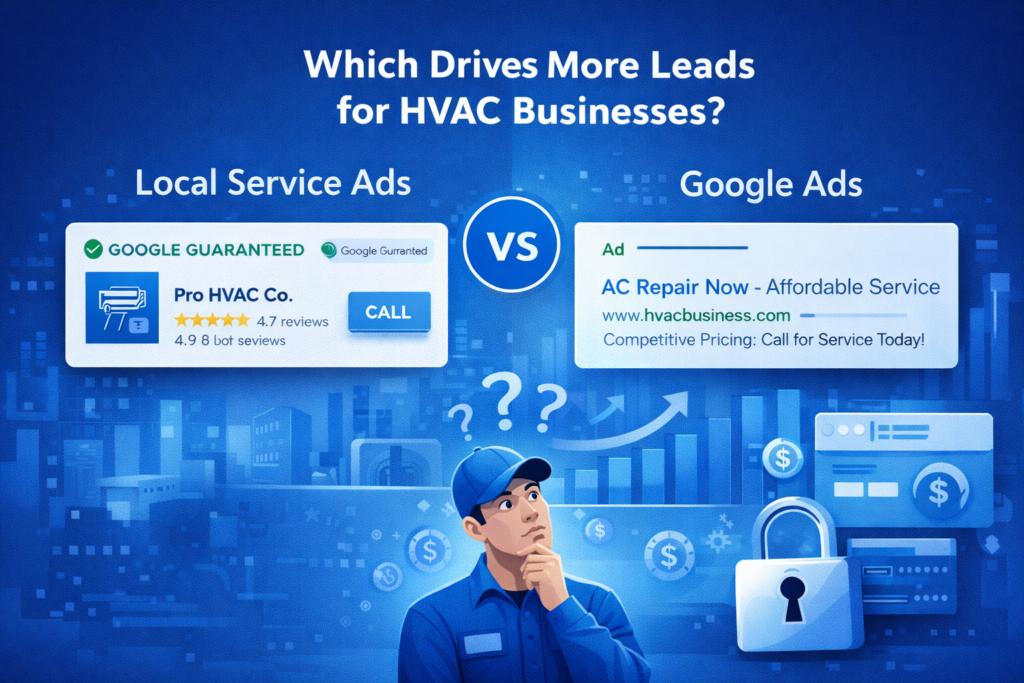
Which is better for HVAC? Local Service Ads or Google Ads
If you’ve been spending all your HVAC marketing budget on Google Ads (GA) with little to no results to show for it, it might be time to consider switching to Local Service Ads (LSAs). But first, we’ll help you learn which is a better fit for your business in this Local Services vs Google Ads comparison article.
LSAs often target high-intent searches like “HVAC near me,” while GA targets more general keywords. In this guide, we’ll break down both platforms by comparing the costs, conversion data, and decision criteria so you can choose what works for your business.
At Klutch Growth, we’ve managed Google Ads campaigns for HVAC businesses that generated a 761% increase in conversion rates. We’ve also used Local Service Ads to transform lead generation for businesses where Google Ads didn’t work. So, the answer isn’t always obvious.
Understanding the fundamental difference
These platforms aren’t interchangeable options. They’re different advertising systems with distinct structures, costs, and results offered by the same business.
Core distinction:
- Local Service Ads: Pay-per-lead model where you’re charged only when customers call or message you
- Google Ads: Pay-per-click model where you’re charged each time someone clicks your ad
Where they appear in search results:
- Local Service Ads (top position)
- Google Ads (middle position)
- Organic listings (bottom position)
LSA focuses on trust and immediate contact. Google Ads focuses on targeting, control, and website traffic. Both target local intent searches, but they approach conversion differently.
Understanding this distinction helps you determine which platform solves your specific problem. So let’s break down exactly how each platform works, what they cost, and when one makes more sense than the other for your HVAC business.
What are Local Service Ads?
Picture this at the top of a Google search: A green badge, your business name, your star rating, your hours, and a direct call button. No website visit required. That’s a Google Local Service Ad.
-
How Local Service Ads work
The platform includes either a Google Guaranteed or Google Screened badge, which helps build trust with prospective customers. Users can see your verified business info and call you instantly using a tracked phone number.
The immediate call-to-action changes customer behavior. They can go straight to calling you. They also have the option to browse your website from the ad, and go on to fill out your lead form.
LSAs are currently available for specific service categories, including HVAC, plumbing, electrical, locksmith, house cleaning, handyman, landscaping, and pest control. Google continues expanding categories, but availability varies by location.
-
The Google Guaranteed and Google Screened badges
These badges aren’t just marketing fluff. The Google Guaranteed badge includes up to $2,000 in job protection for customers if they’re unhappy with the work.
Google Screened applies to professional services like legal and real estate. Both require verification, but Guaranteed offers the money-back promise that builds serious trust.
The psychology works. Customers see Google backing your business, and they see a mark of trust and credibility. Trust us when we say that shifts the trust equation significantly.
-
Eligibility requirements and screening process
Getting approved isn’t automatic. Businesses must ensure their Google Business Profile matches exactly, or risk suspension.
What you’ll need:
- Business license verification
- Insurance requirements (general liability and workers’ comp)
- Background checks for business owners and employees
LSA approval typically takes 5-10 business days for straightforward applications. Complex businesses or those with incomplete documentation might take 2-3 weeks. Timeline matters when you’re ready to start advertising.
What disqualifies businesses
Insufficient insurance coverage kills most applications. Your policy limits need to meet Google’s minimums, which vary by service category.
License issues or suspended registrations disqualify you immediately. Poor review history or complaint patterns can also block approval. Google’s screening protects its brand, so if your business has legitimacy issues, LSA won’t be an option.
Next, let’s look at how Google Ads work differently and what targeting capabilities they offer that LSAs don’t.
What are Google Ads (for local businesses)?
Google Ads operates on keywords, unlike LSAs that uses business eligibility. You’re bidding on search terms that trigger your ads when potential customers search.
-
How Google Ads works for service businesses
Your ads appear when someone searches for terms you’ve selected, like “emergency HVAC” or “AC repair near me.” Google Ads appear below LSAs but above organic results in search rankings.
Ad rank gets determined by bid amount, quality score, and ad relevance. Two businesses bidding the exact amount can pay drastically different prices depending on these factors.
Available ad formats:
- Search ads (text-based)
- Display ads (visual banners)
- Performance Max campaigns (automated across Google properties)
Geographic and demographic targeting gives you control that LSA doesn’t offer.
-
Campaign structure and targeting options
Keyword selection determines when your ads appear. Match types control how closely searches need to match your keywords.
Targeting capabilities:
- Location targeting (radius, specific cities, service areas)
- Ad scheduling (business hours or peak times)
- Device targeting (mobile vs desktop)
- Audience targeting and remarketing
This flexibility lets you reach customers at different stages of the decision process. Someone researching “how much does AC repair cost” gets a different message than someone searching “emergency AC repair Miami.”
-
Quality Score and ad rank factors
Quality Score includes three components: expected click-through rate, ad relevance, and landing page experience. This score directly impacts your cost-per-click.
So why do two businesses bidding the exact amount pay different prices? Quality Score. A higher score lowers your actual CPC, while poor scores increase costs.
Optimization opportunities exist through better landing pages, more relevant ad copy, and improved user experience. Google rewards businesses that deliver better customer experiences at lower cost.
Now that you understand how both platforms work, let’s compare them head-to-head across the factors that actually matter for your bottom line.
Head-to-head comparison: LSA vs Google Ads
These platforms serve different purposes, and what works for one business might not work for another. Let’s break down the key differences that affect your wallet and your lead quality.
-
Cost structure and pricing models
LSA (Pay-per-lead):
- You’re charged when customers call or message you
- Weekly budget caps you set and control
- Cost varies by market, service type, and competition (typically $25-$80 per lead for HVAC)
- No wasted spend on unqualified clicks
Google Ads (Pay-per-click):
- You’re charged when someone clicks your ad
- Daily budget with flexibility to adjust
- CPC varies widely by keyword competition ($5-$90+ for competitive HVAC terms)
- Clicks don’t guarantee leads—conversion depends on your landing page and offer
The cost-per-lead averages tell an interesting story. HVAC companies pay around $52 per lead with LSAs, while Google Ads generates leads at roughly $91 per lead on average. But lower cost per lead doesn’t automatically mean better ROI.
-
Lead quality and conversion rates.
LSA: Leads tend to be higher-intent because they see your ratings and call you directly. There’s no landing page friction—they’re ready to talk now.
However, you pay for every contact, even tire-kickers. The dispute system lets you challenge invalid leads, and Google typically refunds 6-7% of LSA spend through credits for unqualified leads.
Google Ads: Quality depends heavily on keyword selection and landing page effectiveness. You have more control over lead qualification through form fields and page content.
You can track the entire customer journey and create nurturing remarketing campaigns. Someone who clicks but doesn’t convert immediately can see your ads again later.
A homeowner just moved to Miami and searches for “HVAC near me” because they need someone reliable on speed dial. They see your LSA with 4.8 stars and the Google Guaranteed badge, call immediately, and book a maintenance inspection.
That same homeowner might click your Google Ads listing while researching “best plumbers in Miami,” browse your service pages, read a few reviews on your website, and call three days later after comparing options. Both lead to customers, but the path looks different.
-
Trust and credibility factors
LSA: The Google Guaranteed badge builds immediate trust because Google has verified your business through background checks and insurance verification. Review ratings display prominently in the ad itself.
The job guarantee backs up the promise with real money—up to $2,000 protection for customers. That’s powerful social proof before you even answer the phone.
Google Ads: No built-in trust signals. You build credibility through ad copy, landing page design, and your website content.
You can include extensions like reviews, callouts, and site links, but they’re less prominent than LSA’s verification badges. Trust comes from your brand presence, not Google’s endorsement.
Review requirements and management
LSA reviews feed directly into ad visibility and your Google Guaranteed status. Poor reviews or declining ratings can reduce your placement or even suspend your LSA account.
Google Ads reviews matter for landing page conversion rates, but they don’t affect whether your ads show up. Managing negative reviews is business-critical for LSAs, while its reputation management for Google Ads.
Both platforms benefit from firm review profiles, but LSAs make reviews a visibility factor rather than just a conversion factor.
Now let’s look at targeting capabilities, tracking options, and the optimization flexibility each platform offers.
-
Targeting and visibility options
LSA: Limited targeting—primarily location-based. You can’t target specific keywords or exclude certain search terms. Service type selection determines when you appear, and hours of operation affect when ads show.
You’re visible for all relevant searches in your category. Can’t narrow down to “AC installation” without also showing for “AC repair.”
Google Ads: Granular keyword targeting lets you focus on precisely what you want. Negative keywords exclude irrelevant searches that waste budget.
You can layer audiences by demographics, interests, and in-market signals. Remarketing follows previous site visitors. Ad scheduling controls when ads run by hour and day.
-
Measurement and tracking capabilities
LSA: Lead tracking happens through the LSA dashboard. Call recordings are available for review. Message tracking is straightforward.
Limited integration with external analytics. You can’t track beyond the initial contact point. Calculating actual ROI and job completion rates requires manual work.
Google Ads: Full integration with Google Analytics shows the complete view of the customer journey. Conversion tracking monitors website actions—form fills, calls, and bookings.
Call tracking with forwarding numbers attributes phone calls to specific keywords. You can calculate ROI down to the keyword level. LSA tells you how many leads you got. Google Ads tells you which keywords generated leads that became jobs.
-
Control and optimization flexibility
LSA: Limited optimization levers—mainly budget and service categories. You can’t A/B test ad copy or creative. Can’t adjust bids by time of day or specific service.
Performance depends heavily on reviews and response time. The platform optimizes automatically based on these factors.
Google Ads: Extensive testing capabilities for ads, landing pages, and keywords. Bid adjustments by device, location, time, and audience.
Budget allocation based on performance data. Continuous optimization opportunities through Quality Score improvements.
This is where professional Google Ads management creates significant value. The complexity requires knowledge and ongoing attention.
-
Time investment and management requirements
LSA: Initial setup includes background checks and verification—time-consuming upfront. Ongoing management is minimal, primarily focused on responding to leads.
Review management and dispute filing as needed—less technical knowledge required.
Google Ads: Moderate initial setup with campaigns, keywords, landing pages, and conversion tracking. Ongoing optimization requires regular attention.
Technical knowledge helps with Quality Score optimization and bidding strategies. Many business owners underestimate the time required for management, leading to underperforming campaigns.
Quick comparison summary:
| Factor | Local Service Ads | Google Ads |
| Cost Model | Pay-per-lead ($25-$80 for HVAC/plumbing) | Pay-per-click ($5-$90+ per click) |
| Average Cost Per Lead | ~$52 for HVAC | ~$91 for HVAC |
| Lead Quality | Higher intent, immediate contact | Varies by keyword and landing page |
| Trust Signals | Google Guaranteed badge, prominent reviews | No built-in trust, you create it |
| Targeting | Location-based only, broad visibility | Granular keywords, audiences, and remarketing |
| Tracking | Basic dashboard, call recordings | Full Google Analytics integration, keyword-level ROI |
| Optimization Control | Limited (budget, service categories) | Extensive (ads, bids, landing pages, audiences) |
| Time Required | Minimal ongoing management | Regular optimization needed |
| Best For | Simple lead generation, trust-building | Precise targeting, complex customer journeys |
Which platform makes more sense for your specific situation? Let’s break down the scenarios where each one wins.
When Local Service Ads make more sense
LSA works best in specific scenarios. Here’s when you should prioritize it over Google Ads.
-
Your business fits the LSA mold
You need:
- An eligible service category (HVAC, plumbing, electrical, locksmith, etc.)
- All screening requirements met (proper licensing and insurance)
- A strong review profile or the ability to build one quickly
- Clean background checks for owners and employees
If you can’t check these boxes, LSA isn’t an option yet.
-
You prioritize qualified phone calls over website traffic
Your business converts better through phone conversations than online forms. You don’t have a strong website or landing page infrastructure to support Google Ads traffic.
Your services require consultation before booking—emergency services, where immediate contact matters most, benefit from LSA’s direct calling feature.
-
You want simplicity and trust signals.
You have limited marketing bandwidth or expertise to manage complex campaigns. Trust and credibility are your primary conversion barriers, and the Google Guaranteed badge solves that problem.
You want guaranteed lead quality through the dispute system. Budget predictability with weekly caps gives you control without constant monitoring.
-
Your market has lower LSA competition.
Some markets are saturated with LSA advertisers, others aren’t. Check your local search results before committing.
Less competition means lower cost per lead and better visibility. In competitive markets, you struggle to stand out even with good reviews.
When Google Ads make more sense
Google Ads wins when you need precision, control, and sophisticated tracking. Here’s when to choose it.
-
You want targeting precision and control.
You want to promote specific services and not your entire category. You need the ability to exclude services you don’t offer or that aren’t profitable.
Geographic targeting beyond simple radius matters—specific neighborhoods or multiple service areas. Budget allocation based on service profitability gives you strategic control.
-
You have conversion tracking and optimization capabilities
You’ve built strong landing pages for conversion. You can track leads to closed jobs and calculate true ROI.
You have resources for ongoing campaign management, either in-house or through an agency. You’re interested in testing and improving performance over time.
-
Your customer journey is longer or more complex.
You offer high-ticket services requiring research and comparison. You serve B2B and commercial clients, and maybe take on industrial projects as well.
Remarketing adds significant value for services that require customers to take time to decide. You need to nurture leads over days or weeks, before capturing demand.
-
You don’t meet LSA eligibility requirements.
License, insurance, or background check issues block LSA access. Your service category isn’t eligible for LSA yet.
You can’t maintain review requirements or response time standards. Google Ads becomes your default paid advertising option.
But here’s the thing—you don’t always have to choose. Many successful businesses use both platforms strategically.
The hybrid approach: Using both platforms together
Many successful businesses don’t choose one over the other. They use both strategically, allocating budgets based on what each platform does best.
-
How to split your advertising budget
Start with one platform, test thoroughly, then add the second. Don’t split your budget on day one without performance data.
Typical splits run 60/40 or 70/30 based on what performs better. LSA works well for brand-new businesses needing immediate visibility. Add Google Ads once you have baseline LSA performance data to compare against.
-
Complementary strengths of each platform
LSA captures bottom-of-funnel “need service now” searches. Google Ads captures the research phase and remarketing opportunities.
LSA builds trust and credibility through the Google Guaranteed badge. Google Ads provides traffic and data for website optimization. They solve different problems in your customer acquisition strategy.
-
Tracking performance across both platforms
Use separate phone numbers for attribution so you know which platform generated each lead. UTM parameters and call tracking help calculate blended customer acquisition cost.
The critical question isn’t which platform costs less per lead. Which platform drives better customer lifetime value? Track both to make informed budget decisions.
Common mistakes to avoid with each platform
These platforms punish specific mistakes. Here’s what kills performance.
-
Local Service Ads pitfalls
What hurts LSA performance:
- Not responding to leads quickly (response time affects ranking and conversion)
- Ignoring the dispute process for invalid leads (leaving money on the table)
- Letting reviews decline (impacts visibility and conversion rates)
- Setting the budget too low (limits visibility and lead volume)
- Not tracking which leads convert to jobs (can’t calculate real ROI)
Response time matters more than most businesses realize. Customers calling multiple companies book with whoever answers first.
-
Google Ads pitfalls
What hurts Google Ads performance:
- Poor keyword selection (too broad or too competitive wastes budget)
- Sending traffic to the homepage instead of service-specific landing pages
- Not using negative keywords (waste budget on irrelevant clicks)
- Setting campaigns and forgetting them without ongoing optimization
- Ignoring mobile experience (the majority of searches happen on mobile)
The complexity of Google Ads is why many businesses benefit from professional management. We’ve seen companies waste thousands on basic mistakes that a proper campaign structure would prevent.
Step-by-step: How to make your decision
Don’t guess based on what worked for someone else’s business. Use this framework to decide what fits your situation.
-
Assess your business readiness
Run through this checklist:
- Do you meet LSA eligibility requirements (licensing, insurance, background checks)?
- Do you have a conversion-optimized website for Google Ads traffic?
- What’s your monthly advertising budget ($500? $2,000? $5,000+)?
- How much time can you dedicate to campaign management?
- What’s your primary conversion goal (phone calls, form fills, bookings)?
Your answers reveal which platform matches your current capabilities.
-
Evaluate your market competition.
Search your main service terms in your location. Count how many LSA advertisers appear at the top.
Check Google Ads competition using Keyword Planner if you have access. Review competitor websites and landing pages to understand what you’re up against.
Assess the review landscape. Can you compete on ratings if LSA advertisers in your market all have 4.5+ stars?
-
Test with a limited budget first.
Don’t commit your entire budget to an untested platform. Run a 30-day test with $500-$1,000 to gather real data.
- Track these metrics:
- Cost per lead
- Lead quality (qualified vs unqualified)
- Conversion rate to booked jobs
- Revenue per customer
Compare your results against industry benchmarks and your business goals.
-
Scale what works, cut what doesn’t
Be objective about performance data. Some businesses find that neither platform works well because of deeper issues with their offer, pricing, or service quality.
Some find that both platforms work, but one significantly outperforms the other. Adjust budget allocation based on actual ROI, and try to avoid making assumptions or what others say works.
Real-world performance benchmarks
These numbers give you context for evaluating your own results. Performance varies by market, competition, and business quality.
What “good” looks like for LSAs
Cost per lead ranges:
- HVAC: $25-$80 per lead (national average ~$52)
- Plumbing: $24-$69 per lead (national average ~$69)
Response time impacts conversion significantly. Businesses that respond within 5 minutes convert at much higher rates than those that take 30+ minutes.
Review ratings matter. Businesses with 4.5+ star ratings get substantially more visibility and clicks than those with 4.0 or lower ratings.
What “good” looks like for Google Ads
Performance benchmarks for home services:
- Click-through rate: 2.9%-5.7% is typical
- Cost per click: $5-$90+, depending on keyword competition
- Conversion rate (click to lead): 3%-8% for well-optimized campaigns
- Cost per lead: $29-$102 depending on service category
Mobile performance matters. Over 60% of local service searches happen on mobile devices. Your mobile landing page experience directly impacts conversion rates.
Performance comparison at a glance:
| Metric | Local Service Ads | Google Ads |
| HVAC Cost Per Lead | $25-$80 (avg $52) | $29-$102 (varies by service) |
| Plumbing Cost Per Lead | $24-$69 (avg $69) | $29-$102 (varies by service) |
| Click-Through Rate | N/A (pay per lead) | 2.9%-5.7% |
| Cost Per Click | N/A (pay per lead) | $5-$90+ |
| Conversion Rate | Higher intent leads | 3%-8% (click to lead) |
| Response Time Impact | Critical for ranking | Important for conversion |
| Review Rating Impact | Affects visibility & ranking | Affects landing page conversion |
FAQs
- Can I run both Local Service Ads and Google Ads at the same time?
Yes, and many successful businesses do precisely this. They’re complementary platforms serving different parts of your customer acquisition strategy. LSA captures immediate “need service now” searches, while Google Ads handles research-phase traffic and remarketing.
- How much should I spend on Local Service Ads vs Google Ads?
Start with $500-$1,000 per platform per month to gather meaningful data. Businesses typically allocate 60/40 or 70/30 splits based on which platform performs better. Your total budget depends on your market size, competition level, and growth goals. A Miami HVAC company might need $3,000- $5,000 per month across both platforms to compete effectively.
- Do I need a website to run Local Service Ads?
No, LSA doesn’t need a website because customers call you directly through the ad. However, having a professional website builds additional credibility and gives customers a place to research your business before calling.
- What if I’m not Google Guaranteed eligible?
Focus on Google Ads as your primary paid advertising strategy. Work on resolving eligibility issues (licensing, insurance, background checks) so you can add LSA later. Some businesses use Google Ads successfully for years without ever qualifying for LSA. It’s not a requirement for growth.
- Do I need to hire someone to manage Google Ads?
It depends on your budget, time, and technical comfort level. DIY management works if you have time to learn and optimize regularly. Professional management makes sense when your monthly ad spend exceeds $2,000-$3,000 and you don’t see positive ROI after 90 days of self-management, or you want to scale but don’t know how without wasting budget.
Getting expert help with your advertising strategy
Many businesses successfully manage their own advertising. The complexity, time requirements, and optimization knowledge create real barriers for others.
-
When to consider professional Google Ads management
Consider professional help when your monthly ad spend exceeds $2,000-$3,000. At this level, proper optimization pays for itself through improved performance. You want to scale but don’t know how without wasting your ad budget. At Klutch Growth, we specialize in Google Ads for HVAC businesses. Our data-driven campaigns focus on measurable leads and revenue, without the vanity metrics.
Final thoughts: Choose based on your business reality
Neither platform is universally “better.” Your context determines success. LSA offers simplicity and trust through Google’s verification. Google Ads offers control and sophisticated targeting optimization.
Many successful businesses use both platforms strategically, allocating budgets based on what their data shows works. Test, measure, and adjust based on your actual results. The best advertising strategy aligns with your business goals, resources, and market dynamics. Make the decision based on your data, not on what worked for someone else’s business in a different market.
Need help evaluating which platform fits your business? Klutch Growth offers free advertising strategy consultations for HVAC companies. We’ll analyze your market, competition, and goals to recommend the approach that makes sense for your situation.
Recent Posts
March 30, 2026
March 21, 2026
March 20, 2026
February 20, 2026